
Client
Issues
Sales performance varied significantly between private hospital groups, independent hospitals, specialist clinics, and institutional healthcare buyers. The client did not know whether weak results were caused by pricing, low clinical awareness, poor distributor coverage, insufficient technical support, or slow procurement processes. Management needed stronger evidence before changing partners or increasing investment in Bangkok and regional healthcare markets.
Solution
We designed a Thailand healthcare market research programme focused on hospital buyers, procurement structures, clinical influence, competitor positioning, and distributor performance. The engagement helped the client identify priority hospital segments, understand how stakeholders evaluated suppliers, and develop a more targeted commercial strategy.
Approach
We interviewed hospital managers, clinicians, biomedical engineers, procurement teams, laboratory leaders, distributors, and healthcare specialists in Bangkok and selected regional markets. The research examined supplier-selection criteria, purchasing cycles, technical requirements, training expectations, service quality, and price sensitivity. Distributor performance was benchmarked against hospital access, account relationships, regulatory capability, technical support, and geographic coverage.
Recommendations
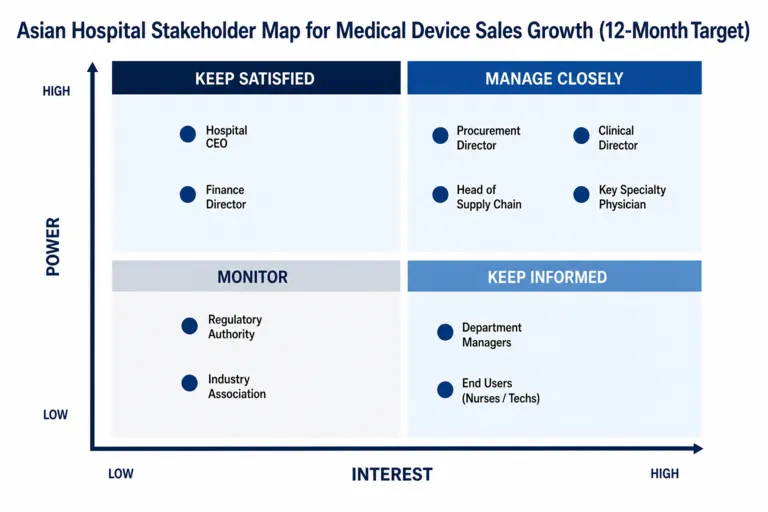
We recommended prioritising private hospital groups and specialist facilities with higher procedure volumes and clearer equipment-replacement demand. Sales teams should involve clinicians and biomedical teams earlier, while distributors should receive stronger technical training and measurable account-development targets. The client should also position its offer around reliability, training, maintenance, and lifetime operating value rather than purchase price alone.
Engagement ROI
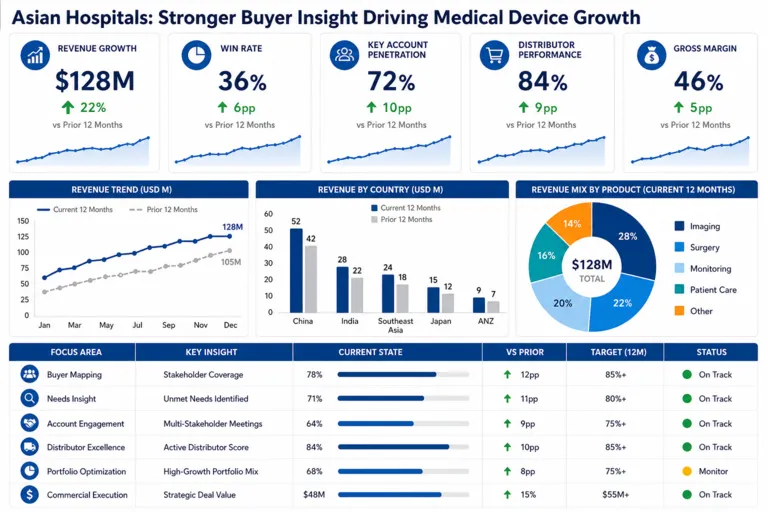
Within 12 months, proposal conversion across priority hospital accounts increased from approximately 22% to 29%. Sales within the targeted institutional segment grew by around 11%, supported by earlier engagement with clinicians, procurement teams, and technical users. One underperforming distributor was replaced, while stronger partner expectations improved the quality of the client’s commercial pipeline.