
Client
Issues
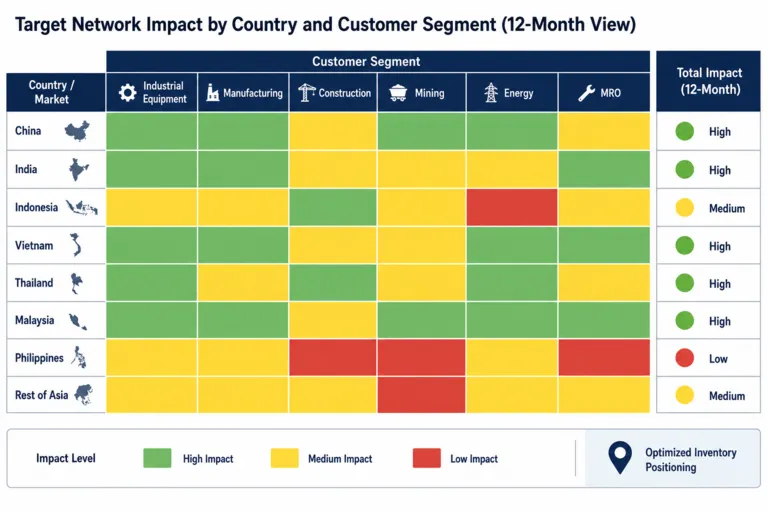
Key accounts experienced long lead times and inconsistent access to spare parts, while distributor capabilities varied significantly. Some partners had strong relationships but limited inventory, while others held stock without actively developing customers. The company needed to improve market coverage without increasing logistics costs or creating further channel conflict.
Solution
We developed a B2B distribution and logistics strategy based on customer requirements, order flows, distributor performance, warehouse demand, and service gaps. The engagement helped the client understand where the network was underperforming and how responsibilities, inventory, and commercial coverage could be reorganised more effectively.
Approach
Our work combined customer interviews, channel mapping, distributor benchmarking, order-pattern analysis, and warehouse-location assessment. We examined lead times, stock availability, service expectations, territory overlap, product demand, logistics costs, and account coverage. Distributors were assessed based on sales activity, customer access, inventory capability, technical support, and growth potential.
Recommendations
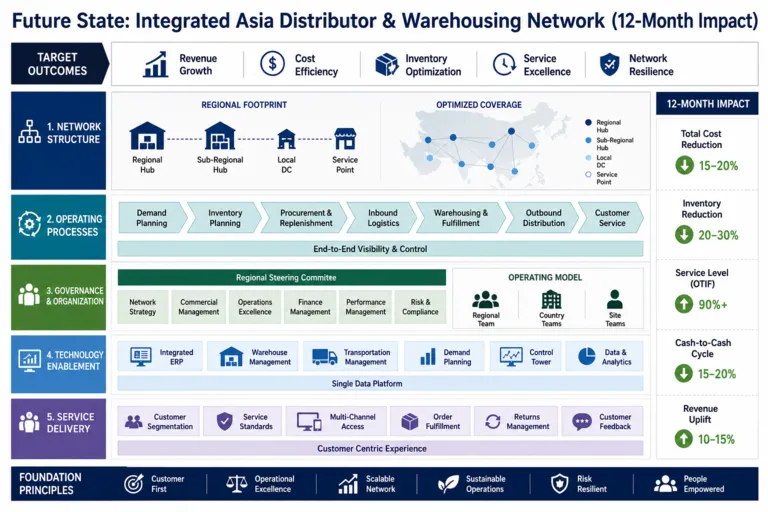
We recommended consolidating overlapping territories, introducing clearer distributor performance standards, and creating a regional stocking model for high-demand equipment and spare parts. Inventory should be positioned closer to priority accounts, while weaker partners should receive defined improvement targets or be replaced where market coverage remained insufficient.
Engagement ROI
Within 12 months, revenue from previously undercovered territories increased by approximately 9%. Product availability across priority accounts improved by around 10 percentage points, while customer complaints related to lead times declined by approximately 18%. Clearer distributor territories and performance expectations also reduced channel conflict and improved accountability across the network.