

Family offices are redrawing Southeast Asia’s private-capital routes. In Singapore, about 600 new single-family offices were added in 2024 alone, taking the total to over 2,000, which Dakota described as a 400% increase on 2020. This growth is not only a headcount story. It is a shift in how families organize decision-making, moving from informal structures toward investment committees, external managers, and more institutional-grade processes. In parallel, next-gen investors are pushing priorities like ESG and private markets, changing how portfolios are built and what “good governance” looks like in practice.
The macro forces are big, but the mechanics are specific. CFA Institute points to generational transfer as a driver, alongside changing investment priorities that require tighter structure. It also cites a broader Asia-Pacific wealth transfer estimated at USD 5.8 trillion by 2030. At the same time, the IMF forecasts 4.3% GDP growth in 2026 for Southeast Asia, compared with 3.1% for the world, reinforcing why families and their advisors keep scanning the region for opportunity. The result is a faster cadence of capital allocation, backed by more professional infrastructure and a stronger demand for specialized expertise.
Singapore Leads, but the Map Is Expanding
Singapore remains the principal wealth management hub in Southeast Asia and the focal point for many family office buildouts. CFA Institute notes the role of ecosystem-building, including the Singapore Wealth Management Institute’s efforts to strengthen advisory capacity for family offices. BigGo Finance adds that Singapore’s single family office population has passed 2,000 and argues that inflows once booked mainly from Southeast Asia now also come from India, Greater China, the Middle East, and Europe. In HSBC’s Global Entrepreneurial Wealth Report, Singapore was named the most attractive hub in the world for business owners, with 15% of entrepreneurs surveyed globally planning to move wealth there and more than one in 10 considering relocating themselves.
That does not mean the region is a one-city story. Malaysia is positioning itself as a challenger. In 2024, Malaysia’s Forest City Special Financial Zone launched a scheme offering tax and residency incentives for high-net-worth families to manage assets through local single-family offices, if they have at least MYR 30 million (USD 7 million) in assets. This kind of threshold-based policy shows how jurisdictions are competing for structures, jobs, and long-duration capital, not just for short-term inflows. It also signals that the Southeast Asia family office wealth hub narrative is increasingly regional, even if Singapore remains the anchor.
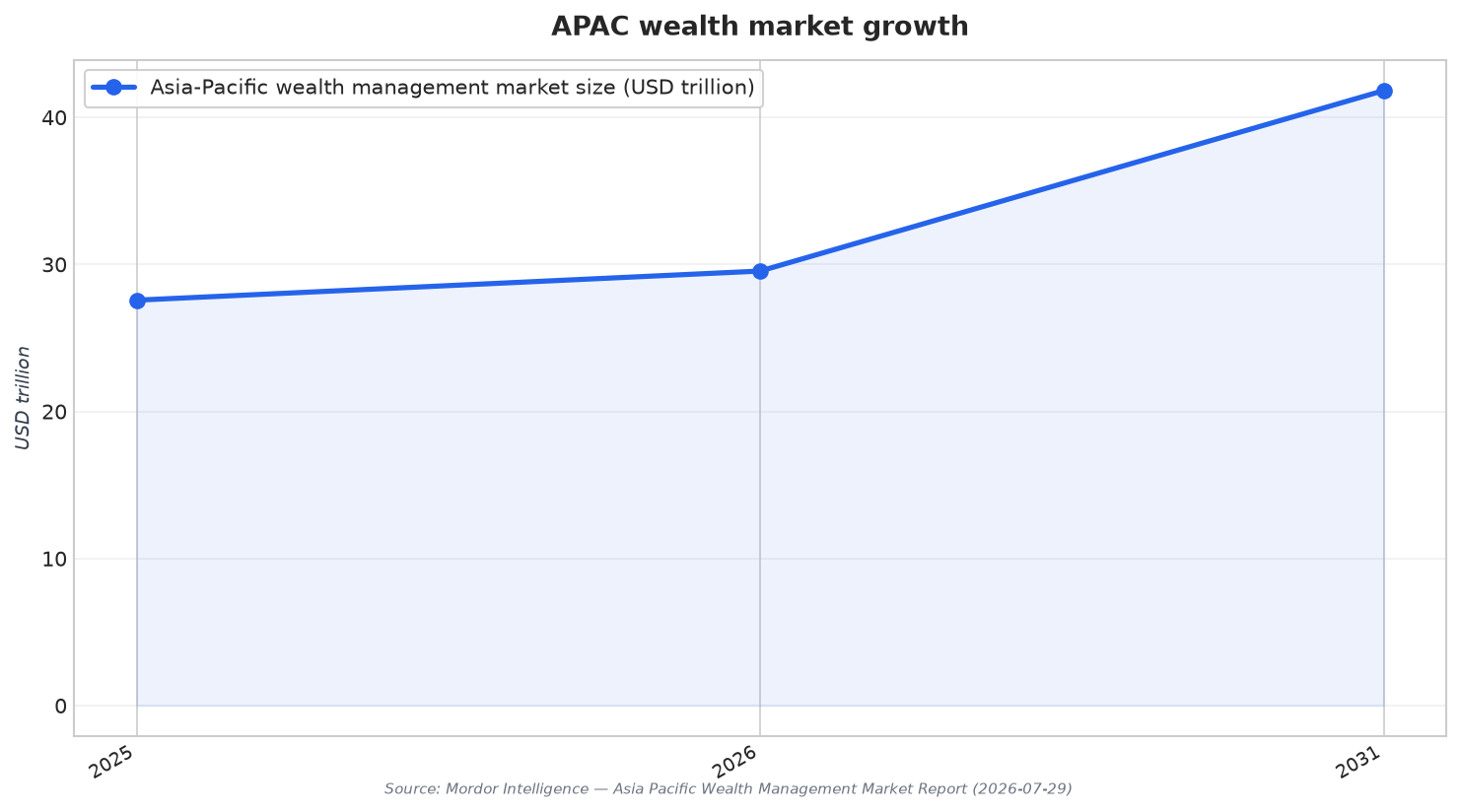
Zooming out, the broader Asia-Pacific wealth backdrop keeps rising. Mordor Intelligence values the Asia-Pacific wealth management market at USD 27.57 trillion in 2025, estimating growth from USD 29.55 trillion in 2026 to USD 41.82 trillion by 2031, at a 7.18% CAGR from 2026 to 2031. In that same report, high-net-worth individuals held 42.74% share in 2025, and private banks held 37.05% share, while fintech advisors are projected to advance at a 15.74% CAGR to 2031. Against that backdrop, family offices in Southeast Asia are professionalizing faster, adopting technology, and increasingly using external managers to navigate cross-border complexity and concentrated private holdings.
How fast are single-family offices growing in Singapore?
Why are next-gen investors changing family office strategies in Southeast Asia?
What policy move is helping Malaysia compete for family office capital?
Why is Singapore described as a focal point for cross-border wealth flows?
What is driving the Southeast Asia family office wealth hub story now?