
Indonesia’s push for rice self-sufficiency is moving from slogan to operating constraint for buyers and suppliers. S&P Global reported that Indonesia did not import rice in 2025 and planned to continue avoiding imports in 2026, relying on domestic production and stockpiles. Market sources told Platts that the decision is expected to have limited impact on regional rice markets, in part because Indonesian buying was already negligible in 2025. A Singapore-based trader also described a bearish trend tied to high production and inventory levels expected to continue into 2026, with any meaningful price recovery depending on whether China and Bangladesh step up buying.
The scale of public intervention is also becoming a defining feature of 2026 supply. A report citing Bapanas projected 4 million tons of rice distribution through market intervention programs in 2026, with 2.84 million tons already distributed from January to October. The same report said official projections estimate national rice production at approximately 34.77 million tons in 2026, exceeding estimated domestic demand of 31.10 million tons, and linked the surplus narrative to intensified practices and the controversial food estate program. For B2B channels, this points to a state-shaped market where warehouse throughput, logistics capacity, and procurement execution can matter as much as farmgate supply.
Where the Numbers Create Both Confidence and Risk for Buyers
Confidence in the Indonesia rice food estate self-sufficiency drive depends on which dataset a buyer uses. A 2026 analysis highlighted that multiple official numbers—production, self-sufficiency, reserve, and consumption—come from different agencies with different denominators, and cannot all be true at the same time. It cited paddy output of 34.69 million tonnes in 2025 versus 30.62 million tonnes in 2024, with harvested area rising to 11.32 million hectares from 10.05 million and a reported self-sufficiency ratio moving from 87.14% in 2024 to 110.25% in 2025. The same piece calculated output per hectare at 3.06 tonnes in 2025 versus 3.05 tonnes in 2024, arguing the change was under one percent and that the year-on-year shift looked more like an area story than a yield story.
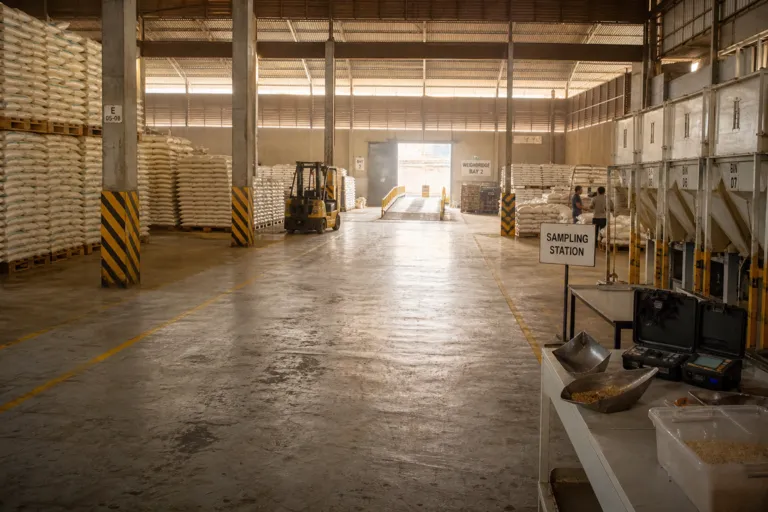
Inventories and procurement claims raise similar diligence questions, even when the headline reads “surplus.” A 2026 report described a Bulog warehouse scene and said state procurement had passed 4.11 million tonnes of farmers’ rice, beating a 4 million tonne target for 2026 with three months to spare, while the national reserve had touched about 5.4 million tonnes and was presented as covering demand into the first quarter of 2027. The same report also said the government claimed the 2026 import order was cancelled, a land-clearing program for new rice fields was being wound down, and officials were exploring premium rice exports to Malaysia. For B2B counterparties, the practical takeaway is to verify which definition of “reserve” and “coverage” is embedded in any contract assumptions.
The food-estate push sits inside a broader agriculture transformation story that will influence procurement, mechanisation, and services demand beyond rice. Ken Research described Indonesia’s USD 144.5 billion agriculture sector in 2023, contributing 12.53% to national GDP and employing 28.77% of the workforce, described as over 40 million people. It also stated agricultural exports surpassed USD 50 billion in 2023 and that FDI in the sector reached USD 1.4 billion that year. The same source said the Food Estate Program (2020–2025) aimed to enhance mechanisation and irrigation infrastructure across Sumatra, Kalimantan, and Papua. For 2026 B2B planning, that combination suggests opportunity, but also a need for cautious forecasting when production, distribution, and self-sufficiency ratios come from different measurement systems.
Will Indonesia import rice in 2026 under its self-sufficiency policy?
What rice distribution volume did Bapanas project for 2026 market interventions?
What do official projections say about 2026 rice production versus domestic demand?
How do measurement issues affect Indonesia’s rice food estate self-sufficiency narrative?
What broader agriculture indicators shape the 2026 B2B stakes around rice?