
Malaysia is positioning its semiconductor sector for a step-change, and the Malaysia National Semiconductor Strategy sits at the centre of that shift. Launched in May 2024, the National Semiconductor Strategy (NSS) is framed around moving beyond traditional assembly, testing, and packaging into chip design, advanced packaging, wafer fabrication, and AI-enabled manufacturing. A U.S. International Trade Administration-linked report described new demand for chip design tools, AI computing infrastructure, advanced manufacturing equipment, and industrial software, alongside collaboration opportunities in R&D and workforce training. The same report said the NSS is supported by an estimated US$5.3 billion in fiscal incentives focused on talent development, R&D, digitalisation, and ecosystem upgrades.
Momentum is visible in the investment pipeline. MITI said the NSS secured more than RM85 billion in approved investments as of December 2025. Another account of early momentum said the initiative attracted over RM63 billion in semiconductor investments within a year of its May 2024 launch. Separately, Malay Mail reported that the NSS aims to attract RM500 billion in combined domestic and foreign semiconductor investment by 2030, alongside training 60,000 high-skilled Malaysian engineers. For investors watching 2026, these numbers show a strategy that is already converting policy direction into approvals while still pointing toward larger targets over the remainder of the decade.
What the 2026 “Investor Opening” Looks Like in Practice
In 2026, the story is not only about announcements, but also about execution capacity and project follow-through. Under the New Industrial Master Plan 2030 (NIMP 2030), MITI said 3,847 manufacturing investment projects worth RM427.9 billion were approved between September 2023 and March 2026, with the potential to create 302,058 new jobs. Of 2,688 projects, or 69.9%, representing RM318.5 billion in approved investments, MITI said they had been realised between 2023 and December 2025. Another 1,076 projects worth RM101.1 billion were described as being in early implementation stages such as site planning and construction. This broader implementation backdrop matters because the semiconductor push depends on factories, suppliers, and timelines actually moving.
Talent and productivity upgrading are being tracked with similarly concrete markers. MITI said the NSS has developed 18,062 highly skilled talents toward a 60,000-worker goal for semiconductor and AI growth. On manufacturing modernisation, 32 factories had been identified as smart factories under the Smart Tech Up programme, while 42 companies had been recognised as smart factories under the Smart Factory Recognition Programme as of May 31, 2026. MITI also said a total of 74 companies had received smart factory recognition by May 31, 2026, and a further 60 companies are expected to achieve the status by end-2026, bringing the total to 134 recognised smart factories by December 2026. For investors, these milestones help indicate readiness for AI-enabled manufacturing ambitions.
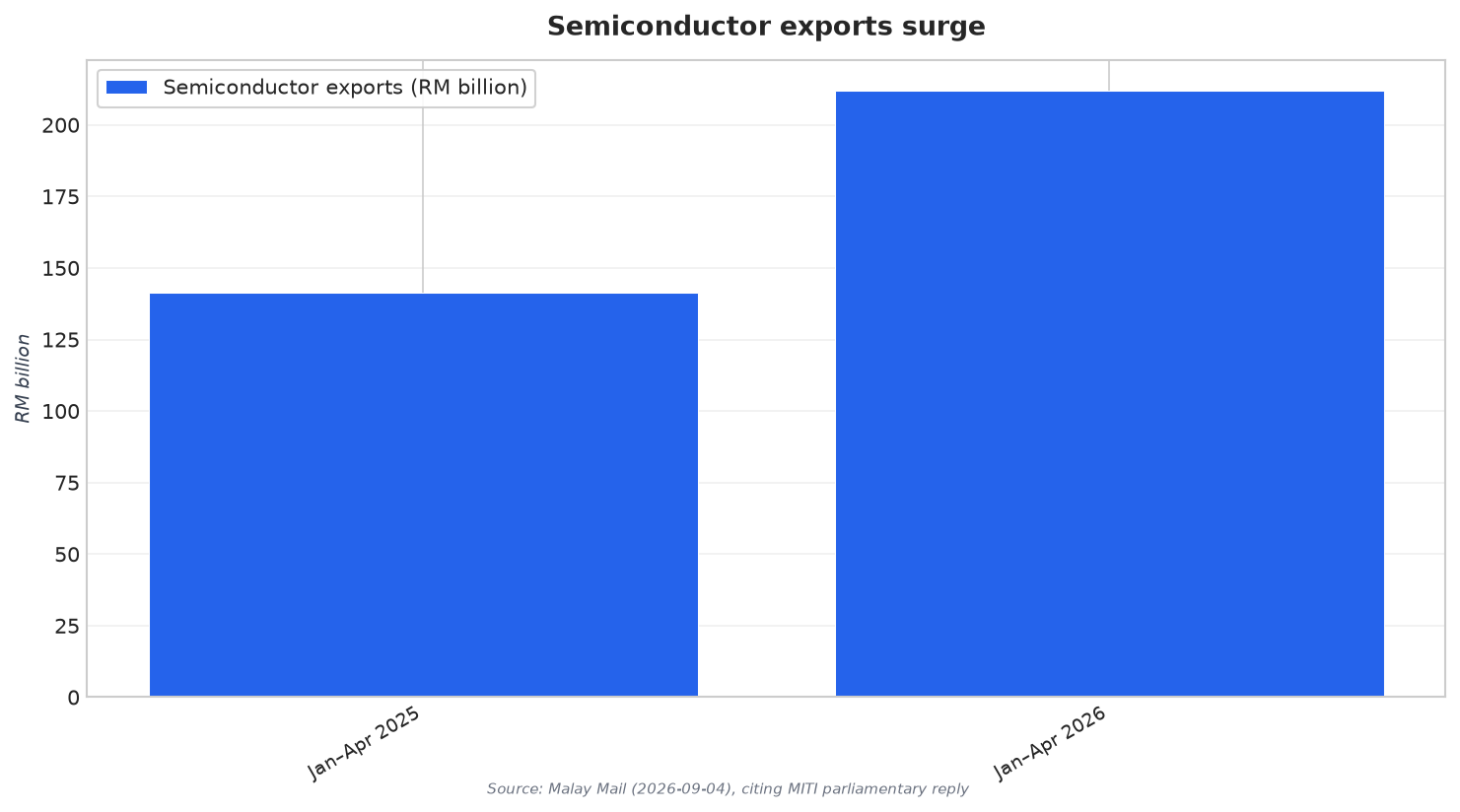
Policy tools and export performance add more context to the 2026 window. A KLSE Screener report said the federal government included RM500 million in soft loans via Bank Pembangunan Malaysia Bhd, earmarked for incentivising domestic R&D and chip design activities, and also noted a road map to develop 60,000 highly skilled professionals and support 110 domestic corporate champions. On market pull, Malay Mail cited MITI figures showing semiconductor exports rising from RM141.23 billion in January–April 2025 to RM212.12 billion in the same period of 2026. These signals combine demand, financing levers, and capability-building, which is what an investor “opening” often looks like when a national strategy transitions from intent to scalable execution.
What is Malaysia’s National Semiconductor Strategy trying to change in the industry?
How much investment has the strategy already secured in approvals?
What is the stated investment target under the National Semiconductor Strategy?
How is talent development tracking against national goals?
Why do 2026 investors care about smart factory recognition figures?