
Indonesia’s Makan Bergizi Gratis (MBG), also called Free Nutritious Meals (FNM), was introduced in 2025 by President Prabowo Subianto and is framed as a national policy tool tied to nutrition outcomes and supply-chain modernization. A 2026 case-study paper describes the program’s intended reach at about 82–83 million people, focused on school-age children, pregnant women, and breastfeeding mothers, while also warning about systemic risks such as food safety weak points, budget inefficiencies, governance breakdowns, and distribution obstacles across the archipelago. For B2B players, the commercial reality is that execution depends on dependable sourcing, scalable production, and distribution that works in both dense cities and remote islands.
The scale signals are already visible in 2026. One logistics analysis reports MBG delivers meals to 49 million people every day, reaching that scale in less than 12 months, and says the target rises to 82.9 million beneficiaries by March 2026. An October 2026 market press note adds that, by the end of September 2026, the program had reached 57 million beneficiaries through 27,486 Nutrition Fulfillment Service Units (SPPG), with Rp153.2 trillion disbursed, while hygiene rules were tightened and 480 additional SPPG were prepared for 3T regions. Together, these figures show why suppliers are racing to become “contract-ready” for a system that keeps adding kitchens, routes, and compliance layers.
Where Procurement Reality Creates the Biggest Supplier Openings
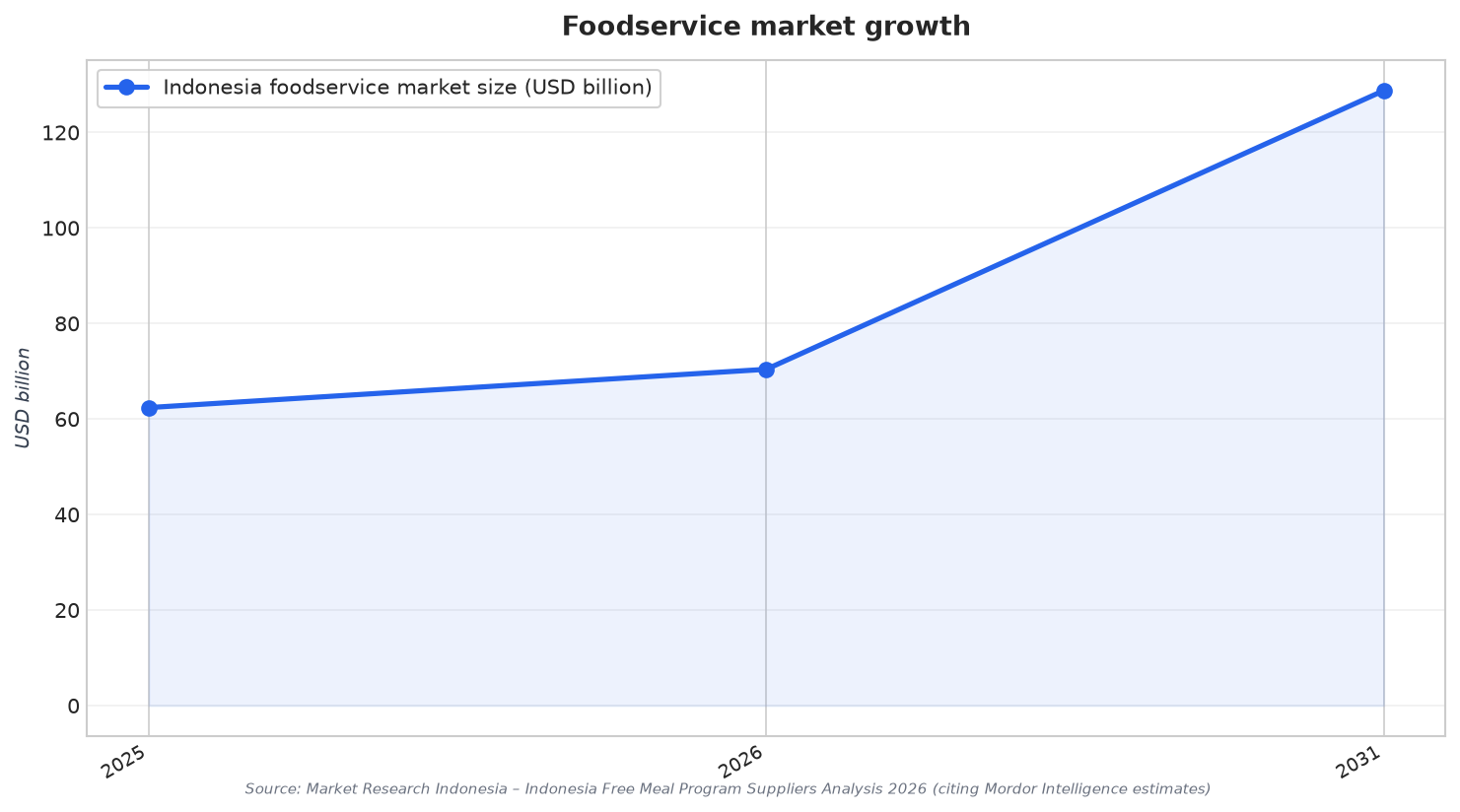
Supplier opportunity sits inside broader foodservice capacity, because MBG needs industrial-grade routines even when meals are cooked locally. One supplier-mapping analysis cites Mordor Intelligence estimates that Indonesia’s foodservice market was USD 62.40 billion in 2025 and USD 70.41 billion in 2026, with projections to USD 128.76 billion by 2031 at a 12.84% CAGR (2026–2031). The same source says that, in 2025, full-service restaurants held 52.67% of foodservice market share, independent operators accounted for 62.41% of market size, and standalone venues held 77.68% share. It also notes takeaway is predicted to grow at a 12.98% CAGR to 2031, a signal that packaging, routing, and standardized handoff processes are becoming more central to institutional meal distribution.
Sourcing strategy is another decisive battlefield in the Indonesia free nutritious meals supply chain, because ingredient exposure can translate into price volatility and delivery risk. Trade.gov figures cited in the supplier analysis put Indonesia’s agricultural imports for fresh products and processed foods at $29.6 billion in 2024, up from over $28 billion in 2022, with frequently imported commodities including soybeans, wheat, rice, beef, fresh fruits, and various feed ingredients. Ken Research is also quoted saying the foodservice industry relies heavily on imported ingredients, with over USD 20 billion worth of food imports annually, and that disruptions and rising import taxes have increased costs for restaurants. In that environment, procurement winners can be those who stabilize pricing, localize inputs where possible, or build blended sourcing that reduces shock transmission into public contracts.
Dairy and cold-chain logistics illustrate how operational constraints become B2B openings. A logistics-focused analysis states Indonesia does not produce enough dairy to meet daily protein needs at MBG’s scale, describing local dairy farming as dominated by smallholders with fragmented and inconsistent output, and it argues that supplying milk daily to tens of millions requires volume, predictability, and refrigeration. The supplier analysis adds context from IndexBox: non-perishable milk categories include UHT liquid milk, evaporated milk, sweetened condensed milk, and milk powder, with total consumption estimated to exceed 1.5 million metric tons per year (product-weight terms), per-capita dairy consumption around 12–16 liters per year (liquid-equivalent), UHT posting 7–10% annual volume growth, and milk powder growing 3–5%. Meanwhile, ANTARA reported 142,387 suppliers participating as of May 22, 2026, and stated the program employs 1.28 million nationwide, underscoring how fast the ecosystem is professionalizing around kitchens, compliance, and delivery.
How far had MBG scaled by late September 2026?
What beneficiary target was cited for March 2026?
How many suppliers were participating in the program as of May 22, 2026?
Why is dairy a critical bottleneck and opportunity for the MBG system?
What does the Indonesia free nutritious meals supply chain need most from B2B partners?