Southeast Asia’s battery story is increasingly being priced from upstream minerals, not just from downstream assembly. IndexBox frames the “World Southeast Asia Battery market” as lithium-ion cells, battery packs, and components made or assembled in the ASEAN-6 economies (Indonesia, Thailand, Malaysia, Vietnam, the Philippines, and Singapore) and exported globally. The same source projects this market to grow at an average 18–22% annually through 2035, and another IndexBox analysis quantifies the 2026–2035 CAGR at 19.8%. The region’s role is described as bifurcated: a major processing hub for materials including nickel, cobalt, and bauxite, and a rising assembly base serving electric vehicles, grid-scale storage, and electronics.
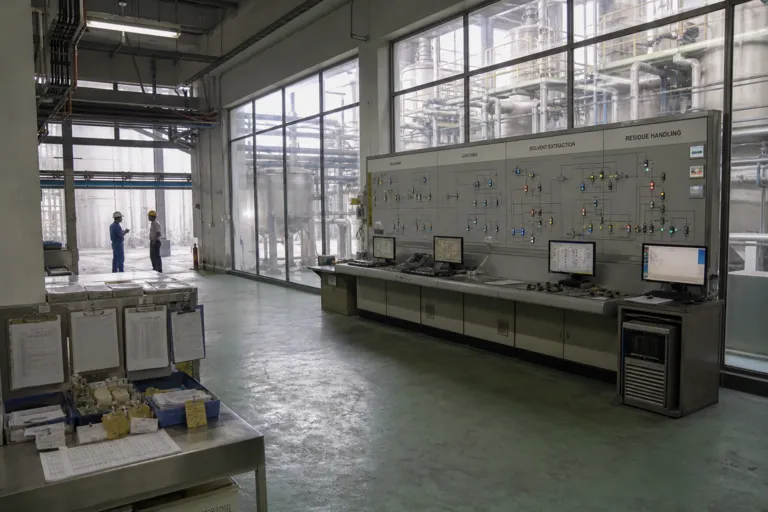
Nickel sits at the center of this shift. IndexBox states that Indonesia alone controls roughly 30–35% of the world’s nickel processing capacity for precursor cathode materials, and it highlights an upstream build-out of over 35 high-pressure acid-leach (HPAL) and rotary-kiln-electric-furnace (RKEF) plants producing mixed-hydroxide-precipitate (MHP) and nickel sulphate. Those outputs feed precursor cathode active material (pCAM) facilities built with Chinese and Korean partners. On the demand side, IndexBox notes that high-nickel NMC demand is expected to rise faster than LFP, with NMC-8 series chemistries at nearly 40% of the region’s 2026 production mix, up from 28% in 2023.
From Ore to Exports: Where ASEAN Captures Value—and Where It Doesn’t
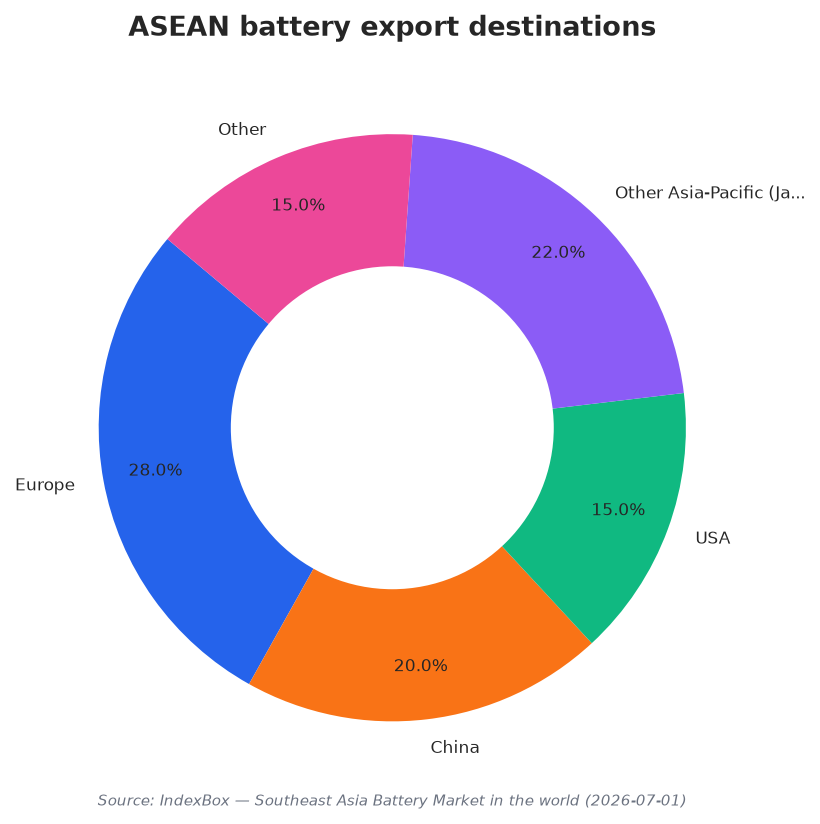
Cell manufacturing capacity is also concentrating in a few ASEAN markets, which reshapes negotiating leverage across the ASEAN critical minerals battery supply chain. IndexBox estimates operational capacity in 2026 at about 45 GWh in Thailand, 30 GWh in Indonesia, 18 GWh in Malaysia, and 12 GWh in Vietnam, with Singapore hosting R&D and pilot lines. Trade flows show how quickly ASEAN output is becoming global supply: in 2025, about 55–60% of the region’s cell output (by GWh) shipped outside ASEAN, primarily to Europe (28% of exports), China (20%), the USA (15%), and other Asia-Pacific markets including Japan, South Korea, and Australia together (22%).
But repricing does not only come from scale; it also comes from frictions and bottlenecks. IndexBox flags lithium processing as a critical constraint: as of 2026, no commercial lithium refinery exists in Southeast Asia, so all lithium carbonate and hydroxide must be imported from Australia, Chile, or China. Policy and compliance also add cost. An IndexBox brief says trade-policy fragmentation—including US Section 301 duties on Chinese content, EU battery due-diligence rules, and the lack of a unified ASEAN certification framework—adds 3–5% to delivered prices. It also notes price premiums of 2–6% above Chinese reference quotes for LFP grades, potentially limiting competitiveness in price-sensitive markets.
Europe’s procurement signals show how minerals and manufacturing incentives can tighten availability. IndexBox’s EU-focused report says several Southeast Asian governments are implementing domestic battery manufacturing incentives tied to local nickel and bauxite processing. It adds that EU importers can face competition for limited cell output, with lead times for large-format cells stretching from 8–10 weeks in 2023 to 14–18 weeks by late 2025. Meanwhile, the IEA notes that rare earth refining concentration has modestly declined due to new projects in the United States and production increases in Malaysia. The same IEA executive summary also highlights price divergence: in Europe, prices for gallium and heavy rare earths (dysprosium and terbium) are around five times higher than Chinese domestic prices, and germanium prices are almost three times higher.
How fast is the Southeast Asia battery market expected to grow through 2035?
What role does Indonesia play in nickel for battery cathode materials?
Where are ASEAN-made battery cells exported, and how much leaves the region?
What is the biggest processing bottleneck in the ASEAN battery value chain as of 2026?
How are policy and compliance affecting the ASEAN critical minerals battery supply chain?