The Philippines’ 2026 investment story is defined by tension. On one side is a market outlook described as cautiously optimistic, supported by domestic demand, government initiatives, and a fast-growing digital economy. Accio’s 2026 overview projects GDP accelerating to around 6.2% in 2026, with consumption supported by low inflation, rising employment, and strong OFW remittances. On the other side is the “growth under siege” critique from ISEAS, which points to governance risk, policy unpredictability, and high electricity and logistics costs as constraints on capital formation. It also reports that in the first quarter of 2026, GDP growth was a mere 2.8%, tied to a continued decline in government capital investment and weaker consumption amid inflation pressures.
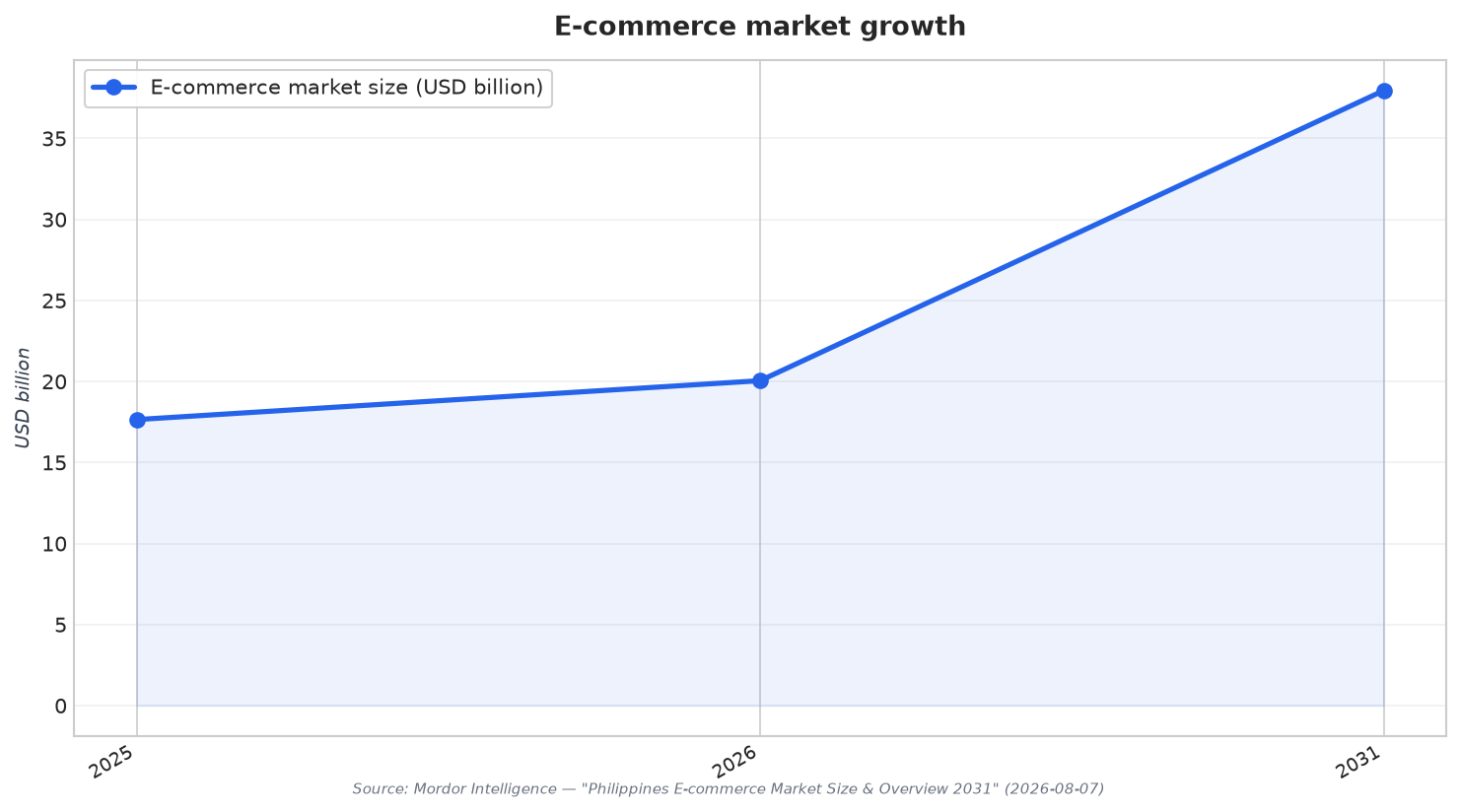
Where are B2B investors still leaning in this debate? Digital commerce infrastructure is one clear hotspot because demand is measurable and the ecosystem is deepening. Mordor Intelligence expects the Philippines e-commerce market to grow from USD 17.65 billion in 2025 to USD 20.05 billion in 2026, and forecasts USD 37.95 billion by 2031 at a 13.61% CAGR. It also notes that B2C transactions captured 91.72% share in 2025, while B2B commerce is projected to expand at a 14.76% CAGR through 2031. Investors watching payments and conversion also have concrete signals: mobile-wallet penetration exceeded 65% in 2024, mobile wallets controlled 64.74% of 2025 B2C value, and smartphones generated 78.52% of sales in 2025.
The Biggest B2B Bets: Data, Services, and Policy-Enabled Capital
Data centers stand out as a second, more infrastructure-heavy bet. Accio projects the Philippine data center market rising from USD 735 million in 2025 to USD 2.48 billion by 2031, implying a 22.50% CAGR. The same source attributes momentum to competitive construction costs, a shift from retail to wholesale colocation driven by cloud migration, and the entry of global operators, while naming ePLDT, Equinix, and Alibaba Cloud among expanding players. For B2B investors, this ties directly to enterprise cloud adoption and the need for resilient, scalable capacity. It also links back to digital trade growth, where stronger logistics and payment rails expand the addressable base for merchants and suppliers across the archipelago.
IT-BPM is the third pillar where foreign capital often seeks durable cash flows and export-facing demand. Offshore 24/7 reports that Philippine IT-BPM export revenues surpassed USD 40 billion in 2025 and that employment reached approximately 1.9 million workers in 2025, after the industry generated USD 38 billion in 2024. Piton-Global frames March 2026 as a USD 42 billion industry employing 2 million people, and also claims the sector has expanded at 5% annually while shifting toward higher-value, “AI Pilot” work. Its details include that non-voice revenue now accounts for nearly 50% of the market and that the industry added 80,000 new high-value jobs, alongside an average 25% increase in pay for reskilled workers. For investors, the bet is less about basic call centers and more about capability centers in analytics, cybersecurity, and AI operations.
Still, the Philippines foreign investment outlook 2026 is not a one-way growth narrative. ISEAS warns that corruption concerns and waning momentum in fighting corruption can erode confidence, and it highlights how climate shocks and weak governance can collide, citing a “flood control mess” as emblematic of this nexus. It also notes an oil price shock linked to the United States’ and Israel’s war on Iran, raising the risk of inflation above target and narrowing central bank policy options. In practice, that pushes B2B investors toward selective exposure: assets with contractual revenues, clear unit economics, and policy tailwinds. Accio points to reforms such as amendments to the Foreign Investment Act and Retail Trade Liberalization Act, plus the Capital Market Efficiency Promotion Act aimed at tax reforms to enhance capital market efficiency, which together shape how investors balance opportunity with execution risk.
What is driving the Philippines’ 2026 investment narrative in opposite directions?
Which digital-market numbers matter most to B2B investors in 2026?
How big is the data center growth opportunity cited for the Philippines?
What scale does the IT-BPM sector reach in 2025–2026 in these sources?
How should investors interpret the Philippines foreign investment outlook for 2026?