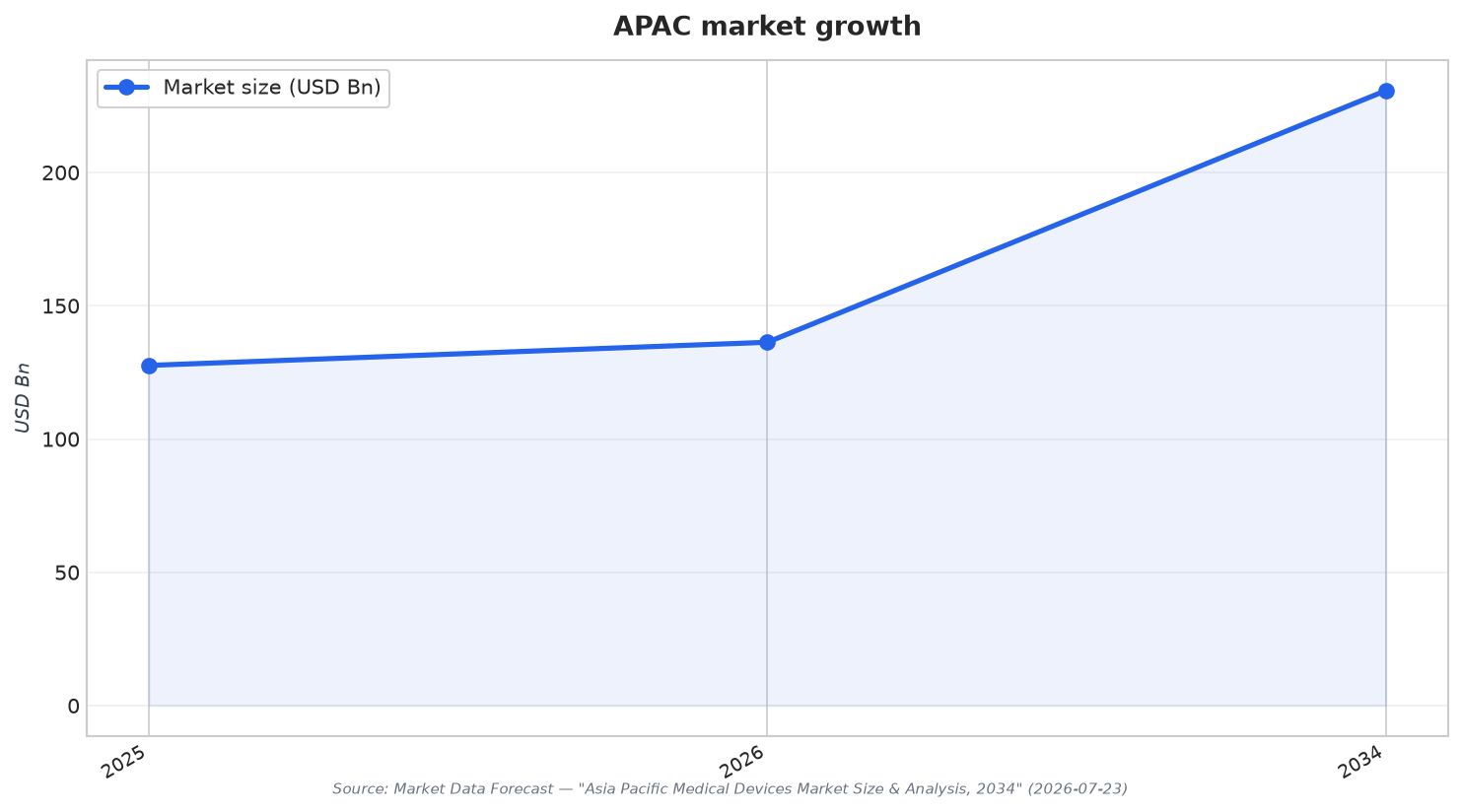
ASEAN sits inside a broader Asia Pacific medical device landscape that multiple sources describe as large and still expanding, with demand shaped by evolving regulatory frameworks and expanding healthcare infrastructure. One source estimates the Asia Pacific medical devices market at USD 127.62 billion in 2025, rising to USD 136.3 billion in 2026, with a forecast of USD 230.71 billion by 2034 and a CAGR of 6.8% from 2026 to 2034. Another source values the Asia-Pacific medical device market at USD 78.25 billion in 2024 and projects USD 147.77 billion by 2032 (CAGR 8.27% from 2026 to 2032). Treat these as regional context: they do not equal ASEAN size, but they explain why manufacturers plan multi-country launches rather than a single-country play.
For Singapore, the sources are more specific on both commercial relevance and compliance obligations. A market report estimates Singapore’s medical devices market at USD 2.3–2.8 billion in 2026, with growth at approximately 7% CAGR. Even with a domestic population of 5.9 million, the same source frames Singapore as a regional distribution hub for Southeast Asia. Buyer-side context also matters: another source states Singapore’s healthcare expenditure crossed SGD 21 billion in 2024 (Ministry of Health Singapore, Healthcare Statistics 2024), and describes the country as a procurement hub for multinational hospital groups across ASEAN. For many companies, this makes Singapore an early anchor market because strong documentation and post-market discipline can become a reusable standard for nearby jurisdictions.
Country-by-Country Registration and Hospital Buyer Signals
Singapore (HSA): The practical sequence described in the sources is to confirm device class against HSA rules, secure CE marking or another reference clearance, appoint a Singapore Registrant, and submit through the appropriate route. The Registrant files through HSA’s MEDICS portal and carries legal responsibility, including post-market vigilance. The buyer guide source adds specific reporting expectations that “mirror EU MDR”: serious adverse events within 10 calendar days, and death or serious public health threat within 48 hours (cited to HSA guidance on Field Safety Corrective Actions). On the hospital and distributor side, the same source points to supplier evaluation using ISO 13485 audits, vendor scoring, quality control checks, FDA and CE certifications, and ongoing performance management. These are not optional talking points; they are what buyers use to reduce risk.
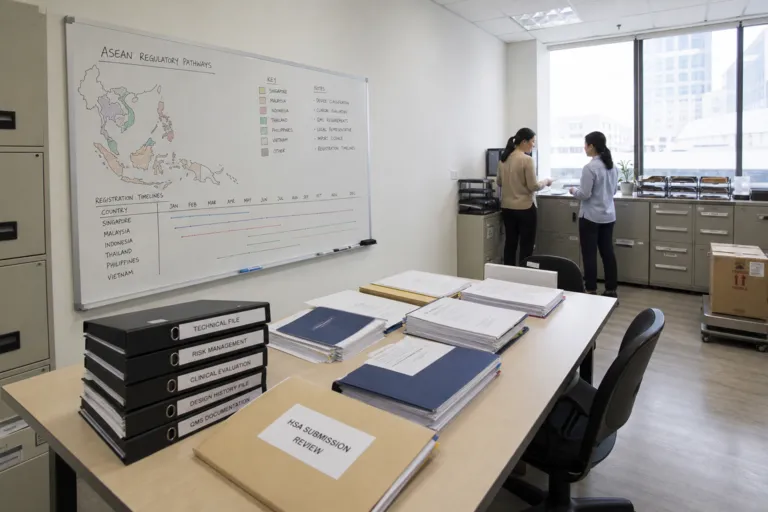
Thailand, Indonesia, and the Philippines: The market access source emphasizes early planning steps rather than fixed timelines. It describes Thai FDA-aligned regulatory intelligence, classification guidance, and feasibility analysis as part of building a structured pathway to entry, and highlights that different ASEAN markets offer different advantages. For Indonesia, the same source anchors “scale” with one explicit figure: Indonesia is the fourth most populous country in the world, with a population exceeding 277 million. It also notes the value of ASEAN CSDT-aligned documentation and country-specific dossier planning aligned to Indonesian procedures. Malaysia and Vietnam: A separate source positions Malaysia, Singapore, and Vietnam as complementary within a regional expansion plan and states that costs are a critical factor when registering across multiple ASEAN countries, particularly for portfolio launches. Across these markets, it stresses that ASEAN registration is rarely linear and that sequencing can balance speed, scale, and regulatory signaling.
To execute a Southeast Asia medical device market entry plan without overextending your team, the sources point toward a phased approach with reusable building blocks. Start with harmonization reality: the ASEAN Medical Device Directive (AMDD) has been in force since 2015 (ASEAN Secretariat), and multiple sources describe alignment with ASEAN principles even when national procedures differ. Then build your buyer-ready package: ISO 13485 evidence, reference approvals such as CE marking, and a vigilance playbook that can meet tight reporting windows where required. Finally, match the “why” of each country to your launch order: Singapore for regulatory signaling and procurement visibility, Thailand for structured planning aligned to Thai FDA procedures, and Indonesia for opportunity tied to population scale (exceeding 277 million), while keeping Malaysia and Vietnam in a coordinated plan where cost and sequencing shape how fast you can expand.
How should companies plan a Southeast Asia medical device market entry across multiple ASEAN countries?
What is the reported size of Singapore’s medical devices market in 2026?
What post-market reporting timelines are cited for Singapore HSA vigilance?
Why is Indonesia highlighted for ASEAN market access planning?
What regional market figures are provided for Asia Pacific medical devices, and how should they be used?