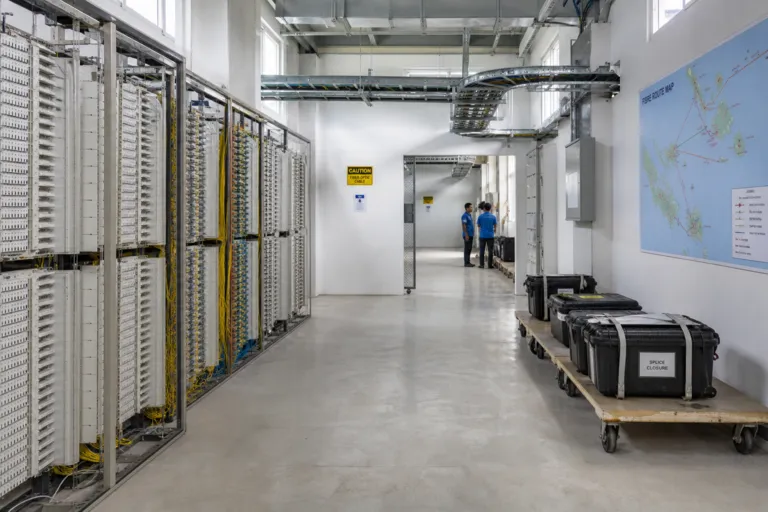
Metro Manila remains the country’s primary hub for colocation and cloud infrastructure, driven by the concentration of financial institutions in Makati and Fort Bonifacio and the advantage of proximity to Batangas submarine cable landing stations. Market reporting also points to Manila as the largest cluster of operational facilities, with around 20 active data centers and 5+ upcoming projects in the city. At the same time, the broader Philippines data center market is being pulled forward by enterprise digitization, cloud adoption, and the rise of shared platforms that consolidate public services on common infrastructure.
On the demand side, large user segments are getting more compute-intensive and more latency-sensitive. The BPO sector alone accounts for roughly 1.6 million seats nationwide, and sources describe digital infrastructure growth accelerating as these enterprises migrate to hybrid-cloud architectures. Financial services are also a catalyst. The Bangko Sentral ng Pilipinas reported that 50% of retail payments were digital in 2024, pushing demand for faster processing and stronger business-continuity controls. Union Bank’s modernization reduced loan approval cycles from six weeks to under three minutes, illustrating what proximate compute can unlock for customer experience and operational speed.
Policy, Cables, and New Corridors Beyond the Capital
Government action is reinforcing the investment case. Republic Act 11659 opened telecom and data-center ownership to full foreign equity, removing the previous 40% ceiling. Separately, the DICT’s PHP 28 billion e-Government Master Plan, announced in late 2023, earmarks funding for government cloud hosting and disaster-recovery facilities across Luzon and the Visayas, aligning with the National Cloud First Policy that obliges public agencies to migrate workloads. In parallel, the Bases Conversion and Development Authority leased 47 hectares in New Clark City for a 300-MW, USD 2.7 billion hyperscale campus, a visible example of land allocation and incentives supporting large builds.
Connectivity is also expanding the country’s strategic footprint. Eight trans-Pacific systems, including Jupiter, Bifrost, and CAP-1, are expected to land in the Philippines by 2025, lifting available international capacity from 60 Tbps to more than 130 Tbps. Route diversity is widening as well, with Converge ICT’s landing station in Davao positioned as a new option for resilience and traffic paths. Operators are responding by pre-leasing data hall capacity near cable stations in Batangas, Aurora, and Baler, reflecting a practical shift toward redundancy, edge deployments, and regional failover designs that can support multi-site architectures.
These tailwinds show up in market projections and geographic spread. One report values the Philippines Data Center Market at USD 735 million in 2025 and projects USD 2.48 billion by 2031, with a stated CAGR of 22.50%. Another summary projects 103 MW of power capacity and 389 thousand sq. feet of area by 2031, and also cites a colocation revenue figure of USD 800 million for 2031. Manila continues to dominate by concentration, but provincial corridors are gaining momentum: Metro Manila is described as capturing about 25% of installed IT load capacity, while Clark in Pampanga and Bamban in Tarlac are highlighted for growth, supported by cheaper land, dedicated power substations, PEZA-incentivized zones, and greenfield availability near planned solar farms. In the Visayas, Globe Telecom launched a 5 MW edge data center in Cebu in June 2024, underscoring how build-outs are extending beyond the capital.
How big is the Philippines Data Center Market expected to be by 2031?
Why does Manila remain the Philippines’ main data-center hub?
What policy moves are encouraging hyperscale investment in the Philippines?
How is subsea connectivity changing the investment case?
Which areas outside Metro Manila are emerging for new builds?