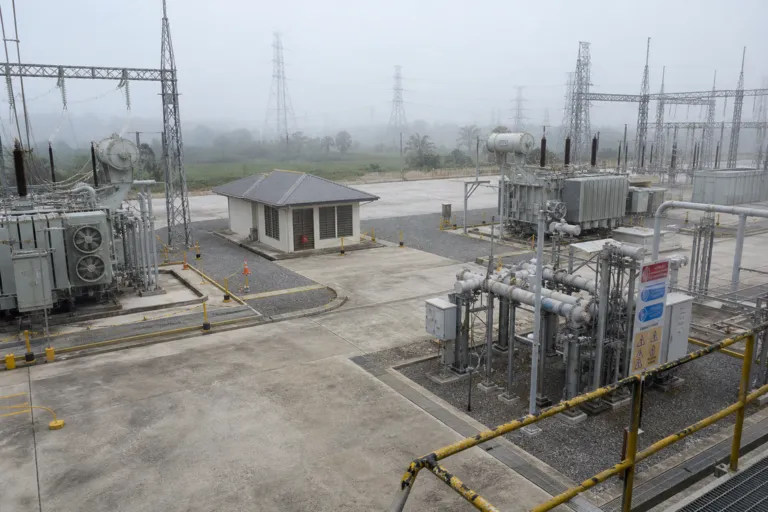
Industrial buyers are starting to feel the practical effects of deeper regional power links, even as the ASEAN Power Grid (APG) remains uneven. ASEAN’s interconnection concept dates back to 1999, and progress has been gradual and mostly bilateral. Still, ASEAN currently has about 7.7 GW of interconnection capacity across nine of its 18 priority projects. These links are concentrated in the Greater Mekong subregion, where surplus hydropower and contiguous grids lower integration costs. For industrial procurement teams, that concentration matters, because the ability to access cross-border supply (and the associated optionality) varies sharply by subregion rather than being a uniform “ASEAN-wide market.”
The region’s most visible proof point is the Laos-Thailand-Malaysia-Singapore Power Integration Project, operational since 2022. It demonstrates technical feasibility, but it is still a controlled pilot. It runs on fixed-volume contracts, not a competitive open market, and it does not yet solve harder issues like congestion management, real-time balancing, or payment settlement across countries. That limitation is directly relevant to buyers who need firm delivery schedules, transparent emissions accounting, and bankable offtake structures. A Bain & Company and Standard Chartered report summarized in regional coverage argues that concentrated, creditworthy demand, especially from data centers, has outpaced transmission and distribution capacity and turned grid constraints into a deciding factor for where capital lands.
What Cross-Border Trade Changes in Buyers’ Power Strategies
For large loads, regional interconnection trade can change both risk and leverage. The International Energy Agency (IEA) estimates ASEAN countries will require more than $300 billion in electricity-grid investment between 2025 and 2040 to expand and modernise networks, and estimates about $27 billion will be needed by 2040 for planned cross-border interconnections under the APG. Those figures signal that grid build-out is central to the region’s industrial growth and electrification story, but also that cross-border projects are complex: multiple governments, regulators, and grid operators must align on technical and commercial terms. Multilateral development banks are therefore positioned as risk reducers that can help projects reach financial close and improve investor confidence.
Indonesia illustrates how national transmission readiness can shape the value of regional connectivity for buyers. The government has committed up to $38 billion to strengthen Indonesia’s national transmission network, including building 48,000 circuit kilometers of transmission lines over the next decade, as outlined in its Electricity Supply Business Plan. Today, Indonesia imports around 200 MW of electricity from Malaysia to supply parts of Kalimantan not yet connected to the national grid, and it participates in the Brunei–Indonesia–Malaysia–Philippines Power Integration Project (BIMP-PIP) to study multilateral trade. But subsea cables and high-voltage infrastructure are expensive and technically complex across an archipelago, and PLN’s control over both transmission and generation, alongside legal limits on separating these functions, can restrict private investment.
Buyers should connect the APG narrative to site-level infrastructure and equipment realities. IndexBox links ASEAN demand for load-sharing power modules to data center capacity expansion that adds roughly 2–3 GW of new IT load annually across the region through 2030, with data centers representing 35–45% of total unit demand. Renewable integration, including large-scale solar and BESS, accounts for 25–30% of module demand, supported by national targets to deploy over 100 GW of new solar and wind capacity by 2035 across ASEAN member states. At the procurement level, import dependence exceeds 70% of module supply; tariff treatment varies, with preferential rates that can reduce duties to 0–5% for some origins, while non-originating modules may face 5–15% depending on the importing country. For industrial buyers assessing ASEAN power grid interconnection trade, those supply-chain and compliance frictions can be as decisive as the headline ambition.
How much interconnection capacity does ASEAN have today under the APG agenda?
Is the Laos-Thailand-Malaysia-Singapore power trade project a full electricity market?
What investment figures frame ASEAN grid expansion and cross-border links?
How does Indonesia’s grid plan relate to cross-border electricity trade?
What does ASEAN power-grid interconnection trade mean for industrial buyers beyond prices?