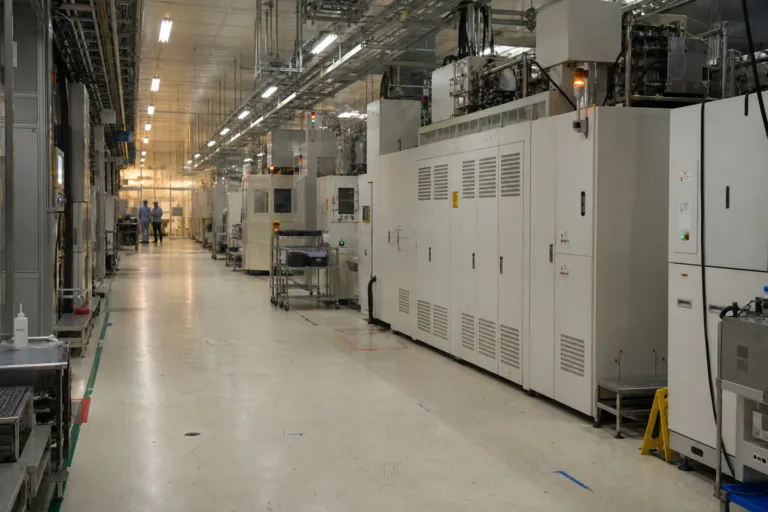
Southeast Asia is no longer framed only as a low-cost electronics assembly base. Regional growth in wafer fabs, OSAT plants, advanced packaging, power semiconductor lines, memory expansions, and test operations is increasingly tied to what equipment suppliers sell and service. One demand proxy cited in public market signals is that the Southeast Asia semiconductor market is projected to expand from USD 3.5 billion in 2025 to USD 3.9 billion by 2032, at a 4.5% CAGR. Another proxy is global: semiconductor equipment billings reached USD 135.1 billion in 2025, up 15% year on year, reflecting higher equipment spend as AI demand, advanced logic, memory, packaging, and test intensity rise worldwide.
Within this corridor, each country’s specialization matters because equipment demand follows capacity buildout, process complexity, and localization pressure. Singapore is positioned as an anchor for wafer fabrication and semiconductor equipment capability, and SEMI describes it as one of the region’s strongest front-end manufacturing bases. Malaysia is widely recognized for outsourced semiconductor assembly and test strength, and SEMI notes capabilities spanning packaging, testing, equipment-related services, and supply chain support. Vietnam is rapidly scaling assembly, test, and packaging footprint, reinforcing why the region is increasingly described as a Southeast Asia semiconductor equipment hub where tool vendors win by pairing reliability with local service, support, and cost-efficient deployment.
Why the Corridor Is Expanding Now
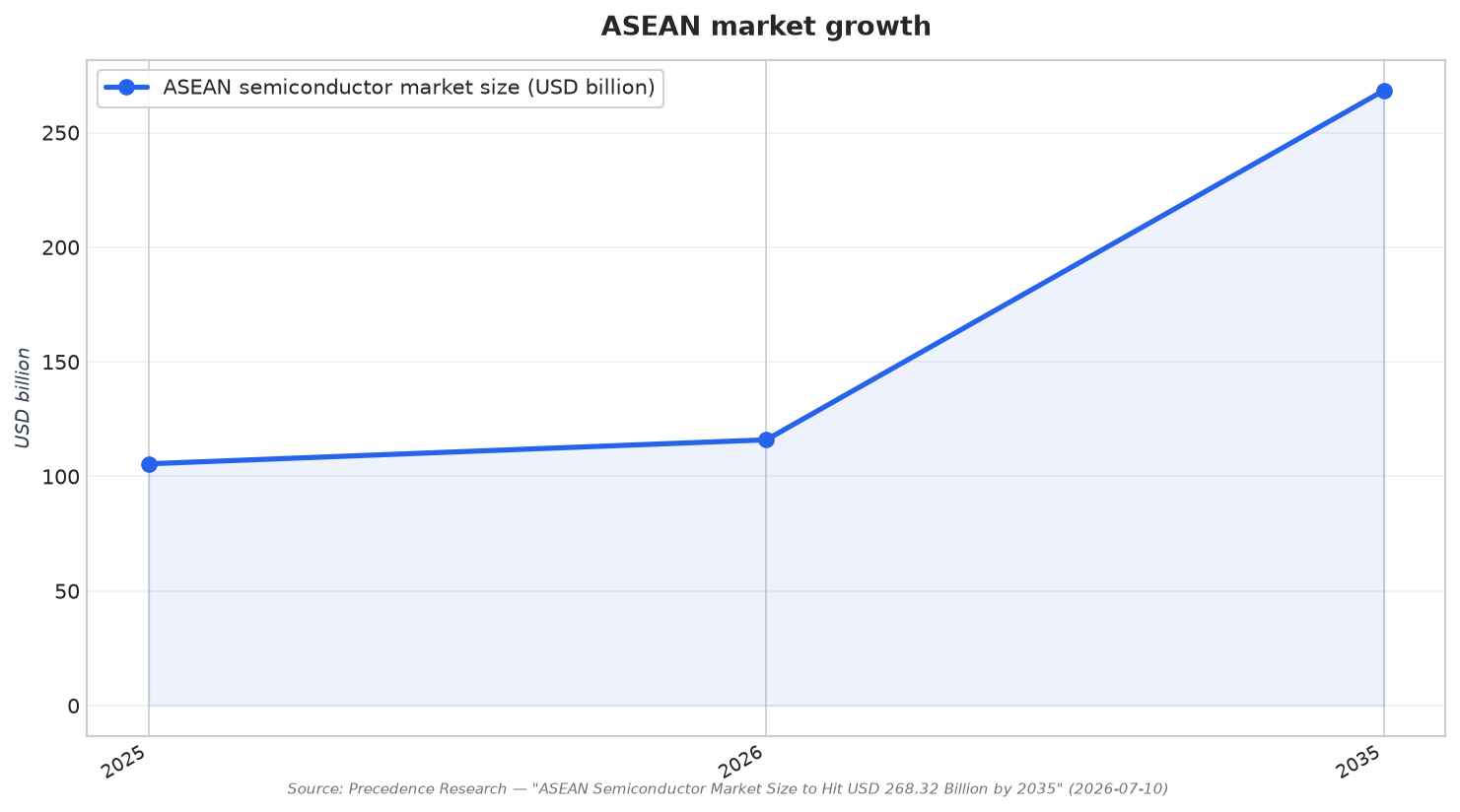
Market-size forecasts for ASEAN also point to rising downstream requirements that translate into tools, spares, and process support. Precedence Research accounts the ASEAN semiconductor market at USD 105.49 billion in 2025, projecting USD 115.96 billion in 2026 and approximately USD 268.32 billion by 2035, at a 9.79% CAGR from 2026 to 2035. In the same outlook, Malaysia dominated the ASEAN semiconductor market with the largest share in 2025, while Thailand and Vietnam are expected to grow at a notable CAGR. It also notes that memory devices held the largest component share in 2025, and that automotive is expected to grow at the fastest CAGR by application, which aligns with more packaging, testing, and reliability-related equipment needs.
Policy design and industrial corridors are being used to pull specific types of semiconductor activity into place. MarkWide Research notes Malaysia’s Ministry of International Trade and Industry administers tax holidays and customs exemptions that shape where packaging and test houses locate capacity. It also states Thailand’s Board of Investment grants eight-year corporate tax exemptions to electric vehicle component producers, and Vietnam’s Ministry of Planning and Investment offers 50-year industrial zone leases with streamlined customs procedures. SEMI ties this direction to Malaysia’s National Semiconductor Strategy, describing a focus on modernising OSAT, expanding advanced packaging, growing existing fabs, strengthening power chip capacity, and developing local chip design champions.
Company footprints and ecosystem signals add practical detail to how the corridor is forming. MarkWide Research states Micron Technology leverages an existing Bac Ninh footprint for DRAM packaging operations and that Intel sustains its Ho Chi Minh City chip assembly plant as a strategic export node. A separate regional industry overview states Intel has expanded its Malaysian operations by investing USD 7 billion in advanced ATP facilities. The same source adds that Malaysia holds 13% of the global ATP market, while Singapore’s ASTAR has filed over 15 semiconductor technology patents since 2020 and Singaporean universities graduate more than 40,000 engineers annually. Together, these ingredients support the logic that tools, metrology, facilities equipment, and field service can cluster around Singapore’s front-end base, Malaysia’s packaging depth, and Vietnam’s scaling backend network.
What signals show rising demand for semiconductor equipment in Southeast Asia?
How does Singapore fit into the regional chip-equipment corridor?
Why is Malaysia central to ASEAN packaging and test activity?
What makes Vietnam important to a Southeast Asia semiconductor equipment hub strategy?
How fast is the ASEAN semiconductor market projected to grow?