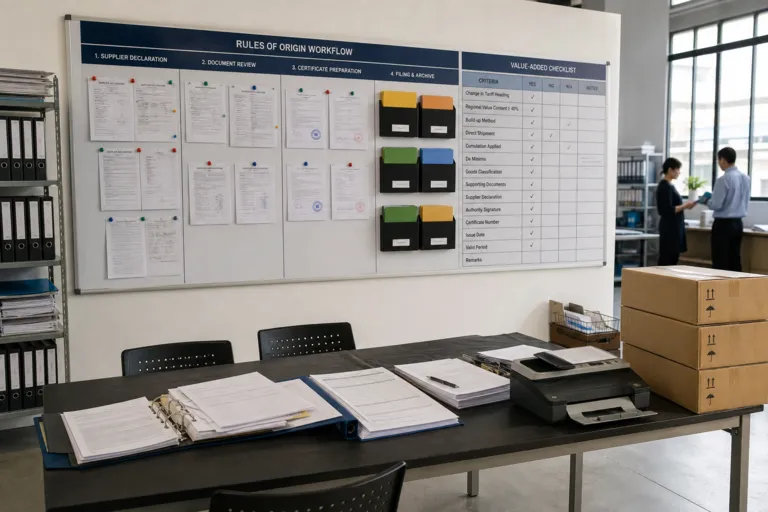
Washington’s renewed focus on origin and content is rewiring ASEAN export strategy, because the easiest pathway to the US market now runs through documentation, traceability, and proof of “substantial transformation.” Transshipment is typically defined as shipping goods via a third country without substantial transformation, and it is difficult to measure in practice. Rules matter because repackaging normally does not qualify as transformation, while assembly sometimes does depending on complexity. That creates a high-stakes compliance question for ASEAN exporters that rely on Chinese components, ownership links, financing, or supplier relationships, all of which can justify scrutiny without automatically making a finished ASEAN product Chinese-origin.
The policy backdrop has widened beyond China-only actions into tariff and enforcement tools that can reach entire value chains. The United States broadened its tariff policy in 2025, targeting strategic sectors including electric vehicles, lithium-ion batteries, solar components, steel, aluminum, and semiconductors. Tariffs on Chinese electric vehicles reached 100%, duties on solar cells climbed to 50%, and lithium-ion batteries were taxed at 25% in 2024. Under revised Section 301 measures, semiconductor imports will face tariffs of up to 50% in 2025. In 2024, US goods imports from ASEAN reached US$352.1 billion, underscoring why origin scrutiny is now a core commercial risk, not a niche customs issue.
Why Proof Is Hard—and Why Enforcement Still Bites
Even when US narratives are aggressive, the evidence base is contested, and that uncertainty changes how exporters plan. A screening approach attributed to the US Council of Economic Advisers looks for patterns where China’s share of US imports falls, China’s share of a third country’s imports rises, and that third country’s share of US imports rises. That pattern can flag risk, but it does not prove that goods merely passed through without meaningful production. One assessment found inconclusive results for five economies, including Indonesia, while Vietnam showed increased domestic content consistent with production reallocation rather than significant one-stop transshipment. Separately, a Harvard study found that 9% of the growth in Vietnamese exports to the US between 2018–21 was due to transshipment, suggesting the practice exists but may be overstated.
At the same time, enforcement intensity is rising, and companies are being forced to operate as if they will be audited. US Customs and Border Protection (CBP) intensified circumvention probes under the Enforce and Protect Act, with cases involving ASEAN economies rising from 6 in 2021 to 20 in 2024. In April 2025, the US Department of Commerce issued anti-dumping and countervailing-duty rulings on solar modules from Cambodia, Malaysia, Thailand, and Vietnam, with some duties exceeding 100%. In Thailand, an analysis of eight industrial groups said US$52.23 billion in exports to the United States in 2025 sat in sectors that could face more intensive origin checks, and that goods worth US$5.2 billion to US$10.4 billion could be exposed to additional scrutiny under assumptions that 10–20% of exports in identified sectors might be examined.
Strategically, ASEAN is not simply choosing between the US consumer market and Chinese supply chains; it is managing dependence on both while upgrading compliance. Asia Society notes that ASEAN economies are selling more to the US while buying more components, machinery, electronics, clean technologies, and industrial goods from China. China is the region’s largest trading partner—roughly one in every five dollars of ASEAN trade—while the US is its fastest-growing major export market, with exports rising 37.5% between 2022 and 2025. Lowy also estimates China’s total share of value-added in ASEAN’s US-bound global value chain exports at 18% (using 2022 data), highlighting why the ASEAN transshipment rules of origin tariff debate is now about proving transformation and tariff classification changes, not just rerouting containers.
What counts as transshipment under US rules-of-origin scrutiny?
How much have US enforcement probes involving ASEAN economies increased?
What figures show the scale of ASEAN’s importance to US imports?
How are Thai exporters being affected by the transshipment crackdown risk tiers?
How is the ASEAN transshipment rules of origin tariff issue changing export strategy?