

Africa market entry for Asian companies depends on more than identifying attractive sectors or potential customers. Businesses need qualified market intelligence, reliable partners, workable financing, efficient logistics, and regulatory understanding before opportunities can become sustainable commercial relationships.
ASEAN–Africa: The Next Corridor, developed by Eurogroup Consulting in collaboration with the Alliance des Patronats Francophones (APF) and the Cambodia Chamber of Commerce (CCC), identifies six enablers for strengthening economic cooperation.
Launched on 14 November 2026 at REF 2026 in Phnom Penh, Cambodia, the whitepaper examines the practical conditions needed to translate growing ASEAN–Africa commercial interest into investment and business operations.
For Asian B2B companies, these findings offer a useful framework for evaluating African expansion.
Why Does African Market Entry Require More Than Demand Data?
Africa comprises markets with different industries, regulations, customer requirements, and business environments.
For B2B exporters and industrial suppliers, broad economic indicators rarely provide enough information to support investment decisions.
Companies need to identify actual buyers, understand procurement requirements, assess competitors, and establish relationships with credible counterparties.
The whitepaper emphasizes that effective market intelligence combines sector data with local expertise and access to decision-makers.
Consider an Indonesian pharmaceutical supplier evaluating Kenya. Population growth and healthcare demand may indicate an opportunity, but the company would still need to identify procurement channels, product-registration requirements, distributors, and financing arrangements.
This illustrates why B2B market research should inform the earliest stages of market-entry planning.
The ASEAN–Africa: The Next Corridor whitepaper examines the institutional and commercial mechanisms needed to strengthen market access.
Six Enablers That Support Successful B2B Expansion
The whitepaper identifies six interconnected enablers that can help companies, institutions, and investors develop more effective business relationships.
For executives, these translate into practical considerations:
- Sector-specific intelligence: Identify qualified customers, suppliers, and projects through reliable market research.
- Trusted partnerships: Verify counterparties and establish clear commercial responsibilities.
- Transaction-based financing: Assess payment security, guarantees, and funding structures early.
- Physical and digital connectivity: Evaluate transport routes, delivery reliability, and trade documentation.
- Regulatory cooperation: Address certification, customs procedures, and relevant market-access requirements.
- Coordinated business development: Build sustained commercial relationships rather than relying on isolated introductions.
These factors are closely connected.
Strong demand may not translate into business if goods cannot be delivered competitively or payments cannot be secured.
Trade Finance Can Determine Whether a Deal Proceeds
Financing is a significant challenge for companies trading across unfamiliar markets.
The whitepaper cites approximately US$81 billion in unmet African trade-finance demand in 2024, highlighting the need for suitable banking and risk-management mechanisms.
For Asian exporters, common concerns include payment uncertainty, foreign-exchange exposure, unfamiliar counterparties, and extended delivery periods.
Appropriate financial instruments may help address these risks, but arrangements must reflect the characteristics of each transaction.
Nicolas Hollanders, Chief Executive Officer of BRED Bank Cambodia, explains in the whitepaper:
"Secured and well-documented instruments such as export credits ensure that funds move smoothly through trusted correspondent banks and that each transaction is completed with certainty."
The whitepaper also highlights a US$500 million syndicated facility secured by African Export-Import Bank (Afreximbank) from Asian banks.
This financing arrangement provides an example of Asian financial institutions supporting African commercial activities.
However, wider financing relationships do not guarantee funding for individual companies. Transaction quality, documentation, risk allocation, and customer creditworthiness remain essential.
Choosing the Right Gateways and Trade Routes
Physical connectivity influences the competitiveness of ASEAN–Africa business relationships.
Singapore, Port Klang, and Tanjung Pelepas are important Southeast Asian maritime gateways, while African ports provide access to regional consumer and industrial markets.
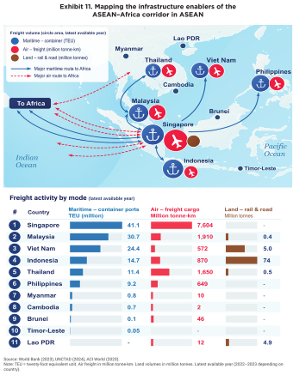
However, shipping connectivity alone is insufficient.
Companies must understand the complete logistics chain, including inland transport, customs procedures, warehousing, and documentation.
Digital trade initiatives can reduce administrative friction where compatible systems and institutions are available.
The whitepaper also discusses the Pan-African Payment and Settlement System (PAPSS), which connected more than 150 banks by July 2025. Importantly, PAPSS is not described as a direct ASEAN–Africa payment bridge.
For businesses, the priority is determining which transport, documentation, and financial systems can support actual transactions.
A Practical Checklist for Asian Companies Entering Africa
The six enablers can guide a phased approach to market entry.
Before committing substantial resources, businesses should evaluate:
- Commercial demand: Identify specific buyers, purchasing requirements, and competitive alternatives.
- Partner credibility: Assess distributors, industrial customers, and potential operating partners.
- Transaction economics: Compare pricing, financing, logistics, duties, and payment risk.
- Implementation readiness: Confirm regulatory obligations and the resources needed to deliver consistently.
This approach helps companies distinguish attractive market narratives from commercially viable opportunities.
The whitepaper emphasizes building repeatable business relationships supported by qualified market information and practical execution capabilities.
Businesses evaluating expansion can use B2B market research and strategy consulting to assess buyers, distribution structures, and market-entry options.
Frequently Asked Questions
What is the biggest barrier to Africa market entry for Asian companies?
A major challenge is identifying commercially qualified opportunities and trustworthy business partners. General market data may indicate demand, but B2B companies also need customer intelligence, procurement insights, financing arrangements, and regulatory knowledge. These factors determine whether a potential opportunity can become a sustainable transaction.
How can ASEAN exporters finance trade with African customers?
Companies may evaluate confirmed letters of credit, guarantees, export credits, and other appropriate financing instruments. Suitable arrangements depend on transaction value, payment terms, counterparties, and country-specific risks. Exporters should involve qualified financial institutions early in commercial negotiations.
Is there a single trade agreement between ASEAN and Africa?
The whitepaper does not identify a comprehensive interregional free trade agreement. Instead, it recommends targeted cooperation in trade documentation, certification, business networks, and market access. Companies must assess applicable regulations and trade arrangements for each country and product.
Why is B2B market research essential for African expansion?
African markets differ in customer requirements, procurement practices, competitive conditions, and regulatory environments. Research helps companies identify qualified buyers, assess pricing and distribution, and verify potential partners. This reduces uncertainty and supports decisions about exporting, local representation, and investment.
Turn African Market Opportunities Into Commercial Partnerships
Africa offers opportunities for Asian exporters, manufacturers, and service providers, but market entry requires reliable information and practical execution.
For decision-makers exploring expansion, the full whitepaper examines six business enablers, key economic gateways, financing mechanisms, and the conditions supporting stronger ASEAN–Africa cooperation.