
By 2026, the conversation about Metro Manila offices is less about a single tenant class and more about what replaces it. The Philippines POGO exit office market story has become a test of how quickly landlords can rebuild demand after years of reliance on offshore-gaming occupiers. POGOs, also known as Internet gaming licensees (IGLs) since October 2023, were described as having become the biggest market for new office space in Metro Manila, with 12% of the stock, according to a compiled account citing Leechiu Property Consultants (LPC). LPC also reported that POGOs vacated a total of 630,000 square meters of office space from 2020 to the third quarter of 2022, and still occupied 1,000,000 square meters as of October 2022.
Policy tightened the timeline. On July 22, 2024, President Marcos announced a nationwide ban of POGOs in his State of the Nation Address, and Executive Order No. 74 was issued on November 5, immediately banning all POGOs or IGLs and offshore gaming operations nationwide, as well as the application and renewal of licenses. In 2026, the Bay Area—one of the districts most associated with POGO-driven demand—was still showing strain. Savills Philippines, as cited by BusinessWorld, said nearly 40% of office space in the Bay Area remained vacant in the first quarter, reflecting continued weakness after the POGO exit. That vacancy is the backdrop for aggressive leasing efforts, repositioning, and a more deliberate push for new occupier categories.
Government Leasing Becomes a Bay Area Shock Absorber
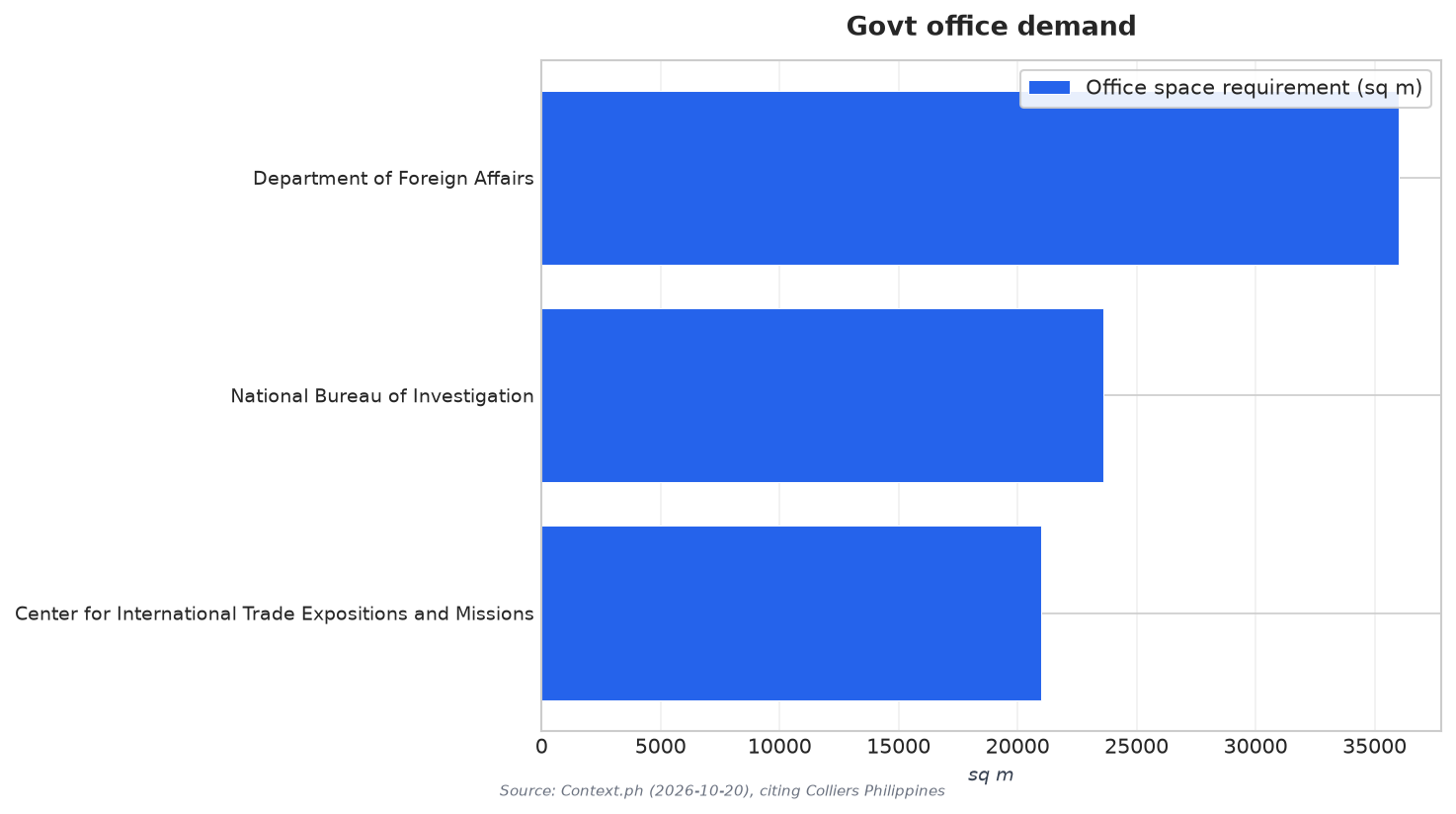
In that reset, public-sector demand has moved from a footnote to a measurable source of take-up. Colliers Philippines reported that six government agencies account for a combined 85,000 square meters of office space requirements in Metro Manila’s Bay Area. The Department of Foreign Affairs represents the largest requirement at 36,000 square meters, followed by the National Bureau of Investigation at 23,600 square meters and the Center for International Trade Expositions and Missions at 21,000 square meters, alongside the Commission on Overseas Filipinos, the Tourism Promotions Board, and the Aurora Pacific Economic Zone and Freeport Authority. Colliers described agencies as capitalizing on competitive rental rates and available properties, offering landlords a way to absorb some space while the tenant landscape shifts.
Still, government leasing is not positioned as a complete replacement for what offshore gaming once provided. Colliers’ commentary stressed that the scale and pace of recovery also depend on private-sector demand, the ability of landlords to match tenant requirements, and the Bay Area’s capacity to attract a broader mix of businesses. Colliers Research Head Joey Roi Bondoc also said stronger office take-up could create spillover demand for residential and retail properties, framing office absorption as a catalyst for wider activity rather than a standalone metric. In practice, that means owners and brokers are selling the Bay Area not just on price, but on accessibility, building quality, and the credibility that comes from anchoring space with stable institutions.
Across Metro Manila, vacancy pressures are also being interpreted through a wider lens than POGOs alone. CBRE’s Real Estate Market Monitor said Metro Manila’s office vacancy reached 19.9% in 2024, translating to nearly 1.8 million square meters of available office space, with 51% attributed to vacated spaces and 49% remaining unleased. CBRE added that, contrary to popular belief, the POGO ban is not the primary cause of increased vacancies, with remarks attributing much of the vacated space to the IT-BPM sector downsizing in certain locations. For 2026, the implication is clear: the post-POGO recovery narrative is also a post-right-sizing narrative, and the next phase hinges on diversifying demand while converting availability into leases that fit how occupiers now use offices.
How is the Philippines POGO exit office market affecting the Bay Area in 2026?
How much office demand are government agencies bringing into the Bay Area?
Which government agencies have the biggest space requirements cited by Colliers?
Was the POGO ban described as the main driver of Metro Manila’s higher vacancy rate?
What does CBRE’s 2024 vacancy figure translate to in available space?