

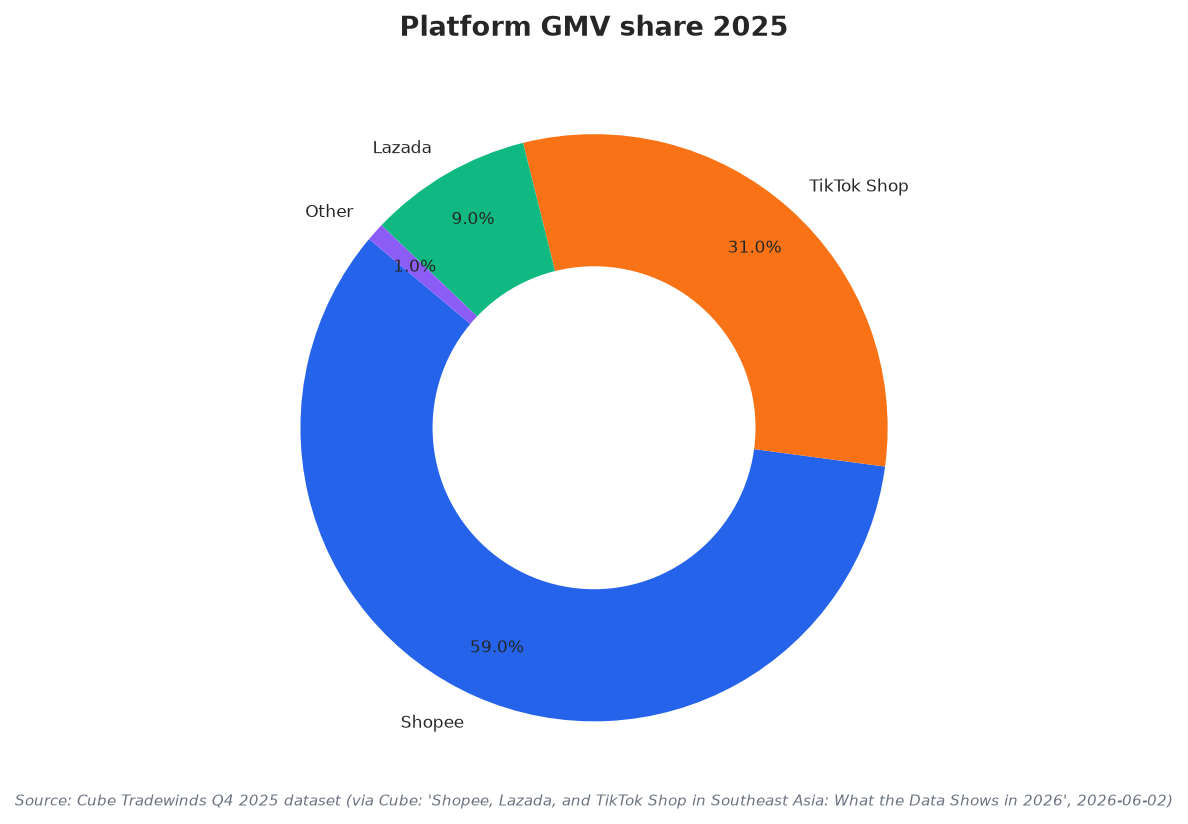
Southeast Asia’s retail playbook is being rewritten by selling through video, creators, and live streams. Across six core markets—Indonesia, Malaysia, the Philippines, Singapore, Thailand, and Vietnam—Cube estimates that combined physical-goods GMV across Shopee, Lazada, and TikTok Shop grew 22% in 2025. But the growth is uneven, and that is the real story for teams planning 2026. Shopee stayed the largest player in FY 2025 with 59% of combined platform GMV and grew 18% year on year. TikTok Shop expanded 66% in 2025 to reach 31% of combined platform GMV, up from 23% the year before. Lazada declined 28% in 2025, and its share fell to 9% from 16% in 2024.
Platform scale still matters, but “habit” and in-app conversion mechanics increasingly decide winners in ASEAN live commerce social selling. Cube notes Shopee’s competitive position is tied to purchase frequency and compounding habit, not just GMV share. Shopee also invested in infrastructure that makes repeat buying easier: Instant Mart and sub-4-hour delivery leveraging ShopeeFood reached Malaysia and the Philippines by the end of Q4 2025. Its VIP membership deepened across markets. Cube also reports that Shopee-native payment methods account for a growing share of transaction volume, reducing reliance on third-party payment infrastructure. These steps do not automatically spike GMV in the short term, but they raise switching costs for both buyers and sellers.
TikTok Shop’s Live Advantage Is Showing Up in the Numbers
TikTok Shop’s surge is not just about listing more products; it is about turning attention into checkout. The China Digital Retail Report says TikTok Shop GMV in Southeast Asia doubled in 2025 and reached USD 34.7 billion in the first half of 2026, an 80% year-over-year increase versus USD 19.2 billion in the first half of 2025. It also estimates TikTok Shop held a 25% to 27% market share by the end of 2025, while Shopee accounted for 39% to 40%. The same report highlights the mechanism behind the jump: live-streaming accounted for 40% of TikTok Shop’s GMV, compared with 15% for Shopee. SpinDepth similarly describes Southeast Asia as TikTok Shop’s “live selling laboratory,” citing the same roughly USD 34.7 billion H1 2026 figure and noting that the region drove most of it.
Country dynamics can still override platform momentum, so sellers need to treat “ASEAN” as a portfolio, not a single market. In Indonesia, the China Digital Retail Report notes that in 2023 the government banned e-commerce transactions on social media, which shut down TikTok Shop at that time. In Vietnam, the same report says TikTok launched TikTok Pay at the end of 2025. It also cites Q&Me’s 2026 Vietnam E-commerce Market Report: the combined GMV of Vietnam’s four largest e-commerce platforms reached USD 13.6 billion between May 2025 and April 2026, up 37% year over year. Shopee remained Vietnam’s leader with a 53% share and GMV of USD 7.29 billion, though its share fell from 61% a year earlier.
Live commerce is also reshaping cross-border strategy, because social discovery and marketplaces are converging. Mordor Intelligence values the Southeast Asia cross-border e-commerce market at USD 50.37 billion in 2026 and projects growth to USD 92.43 billion by 2032 (a 10.58% CAGR for 2027–2032). In that same report, online marketplaces led cross-border sales channels with a 71.91% share in 2026, while social commerce (live, chat) is projected to grow fastest at a 19.2% CAGR during 2027–2032. The report adds a payments signal for Vietnam: MoMo served more than 30 million users in October 2026, connected over 500,000 businesses and merchants, and partnered with more than 70 banks, financial institutions, and insurance companies. For brands selling on live in 2026, the lesson is simple: content drives intent, but payments and fulfillment decide whether intent becomes GMV.
What did Cube estimate for platform GMV share across Shopee, Lazada, and TikTok Shop in FY 2025?
How fast did TikTok Shop grow in Southeast Asia in early 2026?
How much of TikTok Shop GMV comes from live-streaming versus Shopee?
What does the data say about ASEAN live commerce and social selling in Vietnam?
How is cross-border e-commerce linked to social commerce in Southeast Asia?