

Dealmaking momentum is back in Southeast Asia, and healthcare is increasingly in the buyer conversation. In the first half of 2026, Southeast Asia’s M&A market generated USD 50.8bn across 421 deals, according to Mergermarket data. Deal value rose 82% year-on-year from USD 27.9bn, yet deal count slipped to 421 from 430 transactions in 1H25. This pattern matters for Southeast Asia healthcare M&A 2026 because it signals what many acquirers now prioritize: fewer, higher-conviction transactions aimed at assets that can scale and produce visible cash flows.
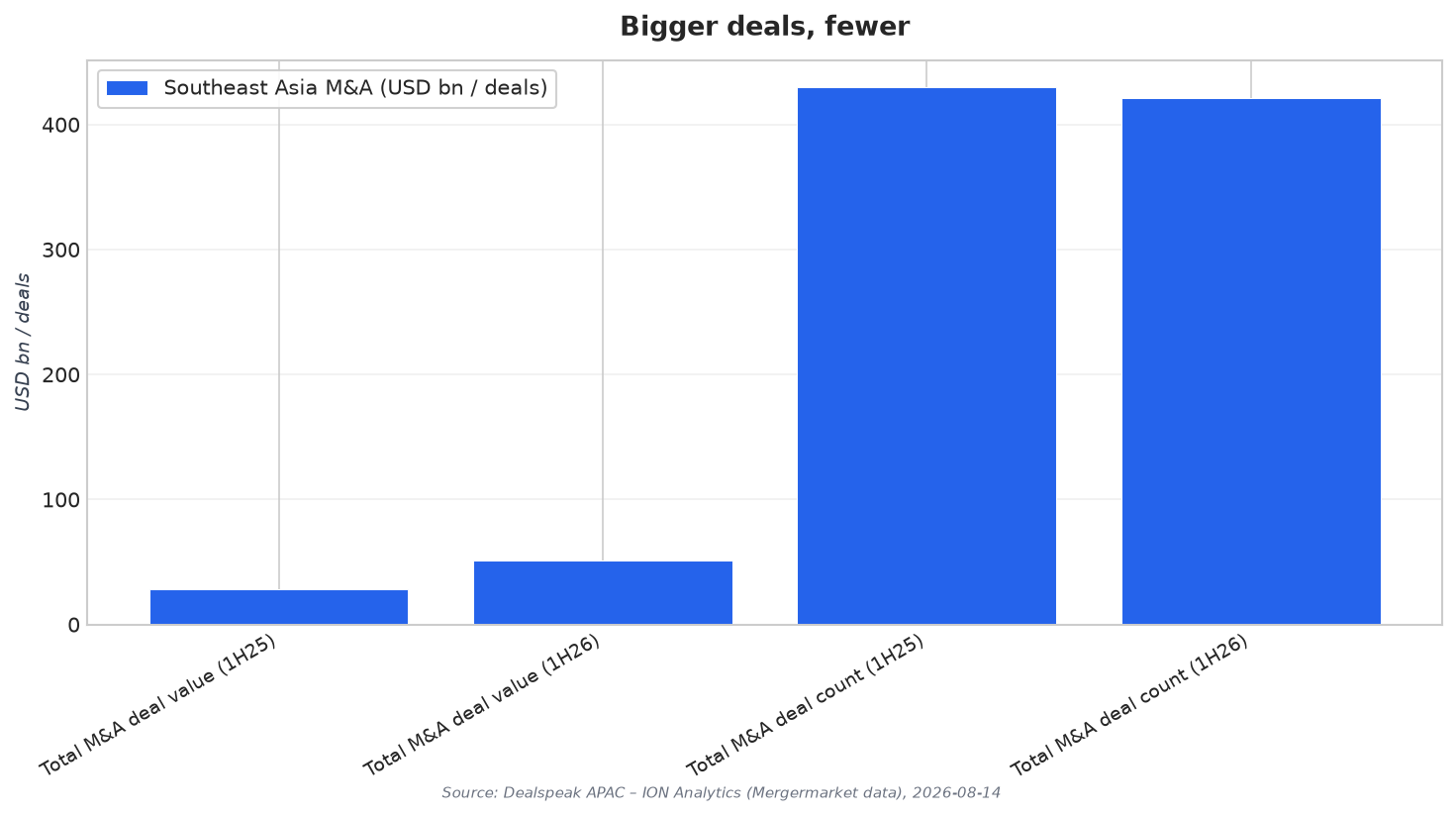
The regional numbers also show how capital can concentrate even as activity levels soften. Domestic deal value climbed 124% to USD 36bn even as transaction numbers fell 4%. Buyout value more than doubled to USD 6bn despite a 33% decline in deal count. Jefferies’ Amrit Kolluru described a “flight to quality,” with capital “chasing scale and proven business models with strong and visible cash flows, as opposed to speculative growth assets.” UBS’ Nicolo Magni added that demand remains strongest for digital infrastructure, healthcare, and companies with defensible market positions and recurring-revenue characteristics.
Why Healthcare Assets Fit the 2026 Buyer Playbook
Healthcare’s appeal is also tied to structural demand and the practical reality of supply constraints. Across Asia Pacific, healthcare is described as one of the most active M&A sectors, supported by aging populations in markets such as Japan, South Korea, Singapore, and Thailand, alongside rising middle-class spending in Southeast Asia that supports private hospitals, clinic chains, and ancillary providers. Another investment theme is the post-pandemic rebound in medical tourism, with Thailand, Singapore, and Malaysia cited among leaders, which can push hospitals and specialty clinics to build capacity, acquire complementary capabilities, and set up cross-border referral networks.
In Southeast Asia specifically, investors are also responding to a measurable infrastructure gap. Indonesia is described as a capacity-expansion play, accounting for roughly 40% of Southeast Asia’s USD 39.1bn annual health-infrastructure need. At the same time, most Southeast Asian governments allocate under 4% of GDP to healthcare, compared with roughly 9% across OECD countries. With around 70% of hospital beds across Asia already privately funded, private capital is positioned to fill shortfalls through consolidation and expansion, including platform-and-bolt-on approaches across hospital groups, diagnostic chains, and specialty care providers.
Execution is not just about picking the right subsector; it is about structuring and operating in diverse regulatory environments. Healthcare regulations can vary by market, including foreign ownership restrictions and licensing requirements, which is why joint ventures with local partners remain a common structure in restricted areas. Regional dealmaking is also shaped by how buyers organize themselves: Singapore is described as where many Southeast Asia deals get done, with fund managers, advisors, and corporate development teams predominantly based there. In 2026, the most consistent healthcare winners are likely to be the ones that combine scale ambitions with compliant structures that work across borders.
What is changing in Southeast Asia healthcare M&A in 2026?
Which Southeast Asia M&A metrics show “fewer deals, larger checks” in 2026?
Why is Indonesia frequently discussed as a healthcare capacity-expansion market?
What funding context supports private investment in Southeast Asian healthcare?