

Green buildings in Southeast Asia are becoming increasingly relevant as developers, property owners, and construction companies seek to reduce energy consumption, improve building performance, and meet evolving environmental expectations. Sustainable construction creates opportunities for specialized materials, engineering, building technologies, and retrofit services, although cost premiums and financing constraints can limit adoption.
The Future ASEAN Sustainable Cities whitepaper by Eurogroup Consulting, developed in cooperation with the French Foreign Trade Advisors (CCE), identifies green architecture as one of eight trends shaping the region's urban development.
With Southeast Asia's cities expanding and cooling requirements increasing, the challenge is no longer simply to construct additional buildings. Developers must also consider how buildings perform over their entire operating life, including energy efficiency, maintenance costs, environmental impact, and long-term asset value.
Green Buildings in Southeast Asia: A Growing Performance Imperative
According to figures cited in Eurogroup Consulting's whitepaper, buildings accounted for 37% of global energy-related carbon dioxide emissions in 2022. This is a global statistic rather than a measurement of ASEAN emissions, but it illustrates the importance of improving building performance.
In Southeast Asia, tropical temperatures and humidity create particularly significant cooling requirements. The whitepaper reports that electricity consumption for cooling increased by 7.5 times between 1990 and 2017. As urban populations and household incomes grow, cooling demand is likely to remain an important consideration for building design and electricity infrastructure.
Green architecture seeks to address these challenges through integrated design. Building orientation, external shading, natural ventilation, efficient cooling systems, and appropriate materials can reduce energy requirements while maintaining indoor comfort.
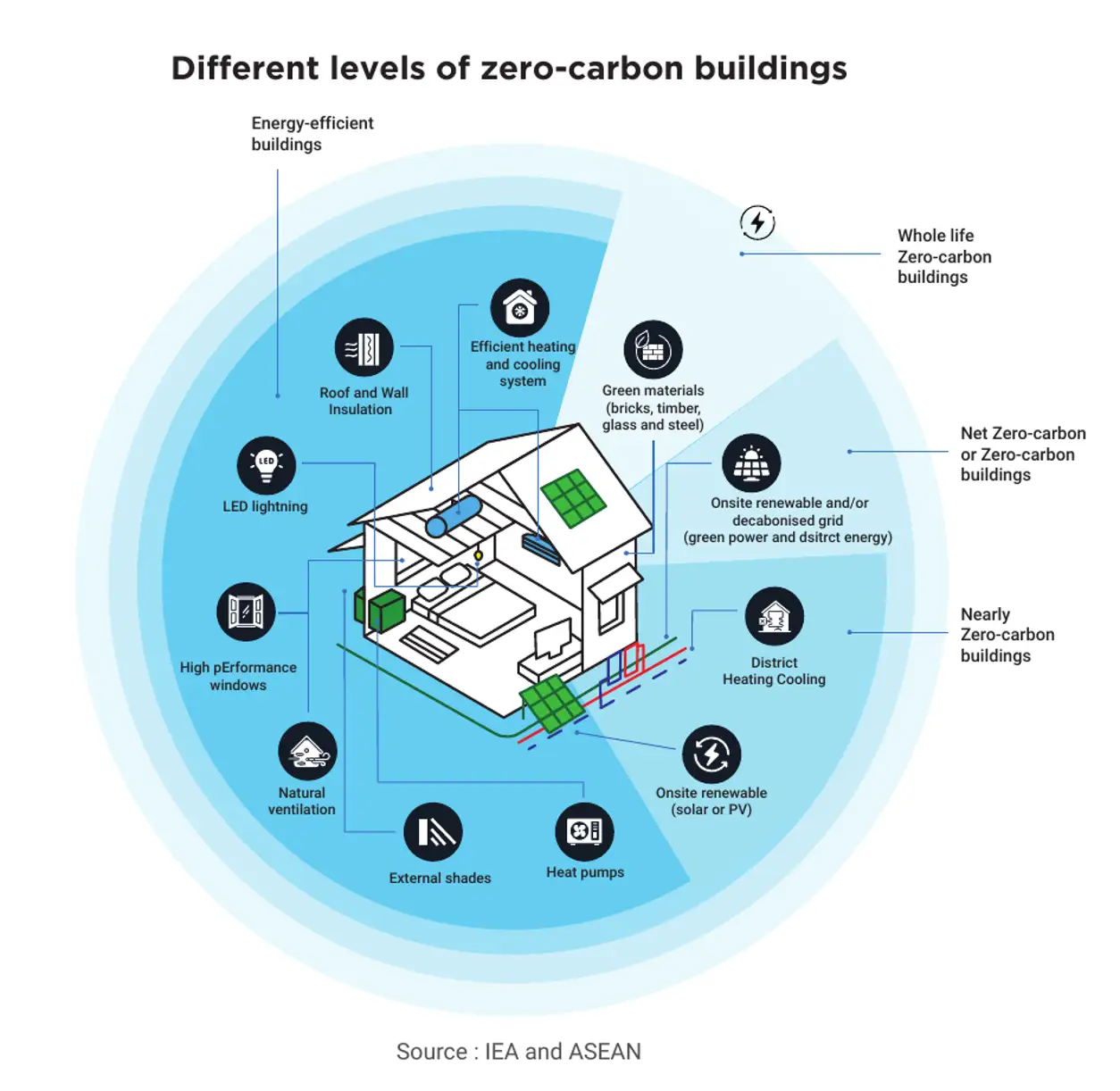
Different Levels of Zero-Carbon Buildings. Source: Future ASEAN Sustainable Cities, Eurogroup Consulting (p. 29), based on IEA and ASEAN.
For owners and operators, lower energy consumption can contribute to lower operating expenditure, particularly in properties with long operating lives. For contractors and technology suppliers, the growing emphasis on performance creates potential demand for specialized engineering and building systems.
From Certification to Construction: Where the Market Is Evolving
Green building certifications offer developers recognized standards for evaluating environmental performance.
The whitepaper identifies Thailand and Malaysia as notable markets for Leadership in Energy and Environmental Design (LEED) certification, citing 448 certified projects in Thailand and 233 in Malaysia in its research snapshot.
Certification can help structure building-performance requirements and provide a common reference for developers, tenants, financial institutions, and project partners. However, certification represents only one part of the opportunity.
For building-material suppliers, the transition may increase interest in products that combine durability, resource efficiency, and appropriate environmental performance. For engineering providers, opportunities include mechanical system optimization, advanced cooling, energy monitoring, and building automation.
The Future ASEAN Sustainable Cities whitepaper examines these developments alongside the region's broader infrastructure and sustainability investment requirements.
What Can ASEAN Learn From Existing Green Building Projects?
Singapore offers examples of both centralized infrastructure and individual building retrofits.
The Marina Bay District Cooling System uses a centralized network to supply chilled water for building cooling. According to the whitepaper, the system can achieve energy savings of up to 40% compared with conventional cooling arrangements and reduce annual carbon emissions by approximately 20,000 tonnes.
A different approach is demonstrated by Keppel Bay Tower. The whitepaper describes how the retrofitting of the building, supported by efficient lighting, advanced air systems, and solar technologies, reduced energy consumption by nearly 50%. Keppel Bay Tower subsequently achieved Singapore's Green Mark Platinum Zero Energy certification in 2020.
These examples demonstrate that sustainable performance improvements are not restricted to newly developed properties. Existing buildings may also provide opportunities for efficiency upgrades, particularly where owners seek to improve performance without replacing entire structures.
Energy and water constraints are also becoming increasingly important in specialized construction segments. Read about how power availability, cooling infrastructure, and water requirements are influencing the development of energy-intensive properties in What Will Shape Malaysia Data Centre Construction in 2026?.
The Cost Premium: Why Green Construction Still Faces Barriers
The Eurogroup Consulting whitepaper indicates that sustainable materials and certification requirements can add approximately 5–10% to development costs. For projects operating with limited budgets, additional upfront expenditure can discourage developers from adopting higher environmental standards.
Some developers may struggle to access dedicated green financing, particularly where eligibility conditions require certifications, technical documentation, or detailed performance assessments. Differences in national regulations and building standards further complicate cross-border operations.
As Pierre-Jean Malgouyres, Co-founder and CEO of Archetype Group, explains in the whitepaper:
"Without financial incentives, the adoption of green standards will remain too slow, and retrofitting later is far more expensive than building sustainably from the outset."
The observation highlights the importance of evaluating building economics over the full asset lifecycle. Lower construction costs do not necessarily translate into lower total costs of ownership. For developers and investors, comparing initial capital expenditure with expected operating savings is therefore essential.
The B2B Opportunity: Solutions That Deliver Measurable Value
Key areas for business consideration include:
- Efficient building systems: Cooling, ventilation, lighting, and automated energy-management technologies.
- Sustainable construction materials: Products designed to improve durability, reduce resource consumption, or support environmental certification.
- Retrofitting services: Engineering, equipment replacement, and building-performance upgrades for existing properties.
- Integrated design expertise: Architecture and engineering services that optimize energy efficiency from early project planning.
- Building performance monitoring: Technologies that track consumption and help operators improve efficiency over time.
A key differentiator will be the ability to connect technical performance with economic outcomes. Suppliers that can demonstrate these outcomes through completed projects may be better positioned than those relying solely on general sustainability claims.
Frequently Asked Questions
What are green buildings in Southeast Asia?
Green buildings are properties designed, constructed, or upgraded to reduce energy consumption, water use, resource waste, and environmental impacts. Certification systems such as LEED, Green Mark, and Green Building Index can provide formal frameworks for assessing performance.
How much more does green construction cost?
The Future ASEAN Sustainable Cities whitepaper indicates that green materials and certification requirements may add approximately 5–10% to upfront development costs. Developers should also consider operating costs, maintenance requirements, energy savings, and the potential expense of future retrofits.
Can existing buildings be converted into green buildings?
Yes. Retrofitting can improve the performance of existing properties through efficient lighting, cooling upgrades, better ventilation, automation, and renewable energy technologies. Singapore's Keppel Bay Tower provides a relevant example, with the whitepaper reporting an energy-consumption reduction of nearly 50%.
Explore the Future of Sustainable Construction in ASEAN
Download the Full Future ASEAN Sustainable Cities Whitepaper
Discover Eurogroup Consulting's full analysis, developed in cooperation with the French Foreign Trade Advisors (CCE), including sustainable construction trends, infrastructure developments, investment perspectives, and recommendations for businesses entering ASEAN markets.