
In 2026, supply-chain planning in Asia is less about one relocation and more about a portfolio. The “China Plus One” strategy has matured into a broader geographic rebalancing of production and service delivery, with India and Southeast Asia competing for similar pools of international investment. At the same time, regional demand and production gravity keeps pulling supply chains toward Asia. AMRO notes that regional production networks evolved from a Japan-centered hub into a dense architecture anchored by China, with trade concentrated in intermediate and capital goods. That context matters for how companies think about India-ASEAN sourcing, assembly, and distribution choices.
India’s economic engagement with ASEAN has expanded but remains uneven in outcomes. Over the past decade, India-ASEAN trade rose from about USD 76.5 billion in FY2014–15 to USD 120.9 billion in FY 2023–24. Yet the trade balance shows a persistent gap: in 2023–24, India’s exports to ASEAN were roughly USD 41.2 billion, while imports were about USD 79.7 billion. For supply-chain leaders, that mix signals two realities at once. First, there is active demand and sourcing between the partners. Second, there is still headroom for India to deepen production-network integration beyond final goods trade.
Why 2026 Supply Chains Are Being Redesigned, Not Just Moved
Rebalancing is a redesign of how much production each country carries, not a complete exit from an existing base. Source of Asia describes it as spreading production, sourcing, and logistics across more than one country to reduce concentration risk and improve long-term flexibility. AMRO’s 2026 outlook adds a structural clue: even as ASEAN doubled, the intraregional share dropped to 14.1 percent, reinforcing the argument for deeper ties to buffer against geopolitics. Companies responding to this environment often split processes across locations—placing selected manufacturing stages in Southeast Asia while keeping other operations elsewhere—so that compliance, continuity, and risk controls improve together.
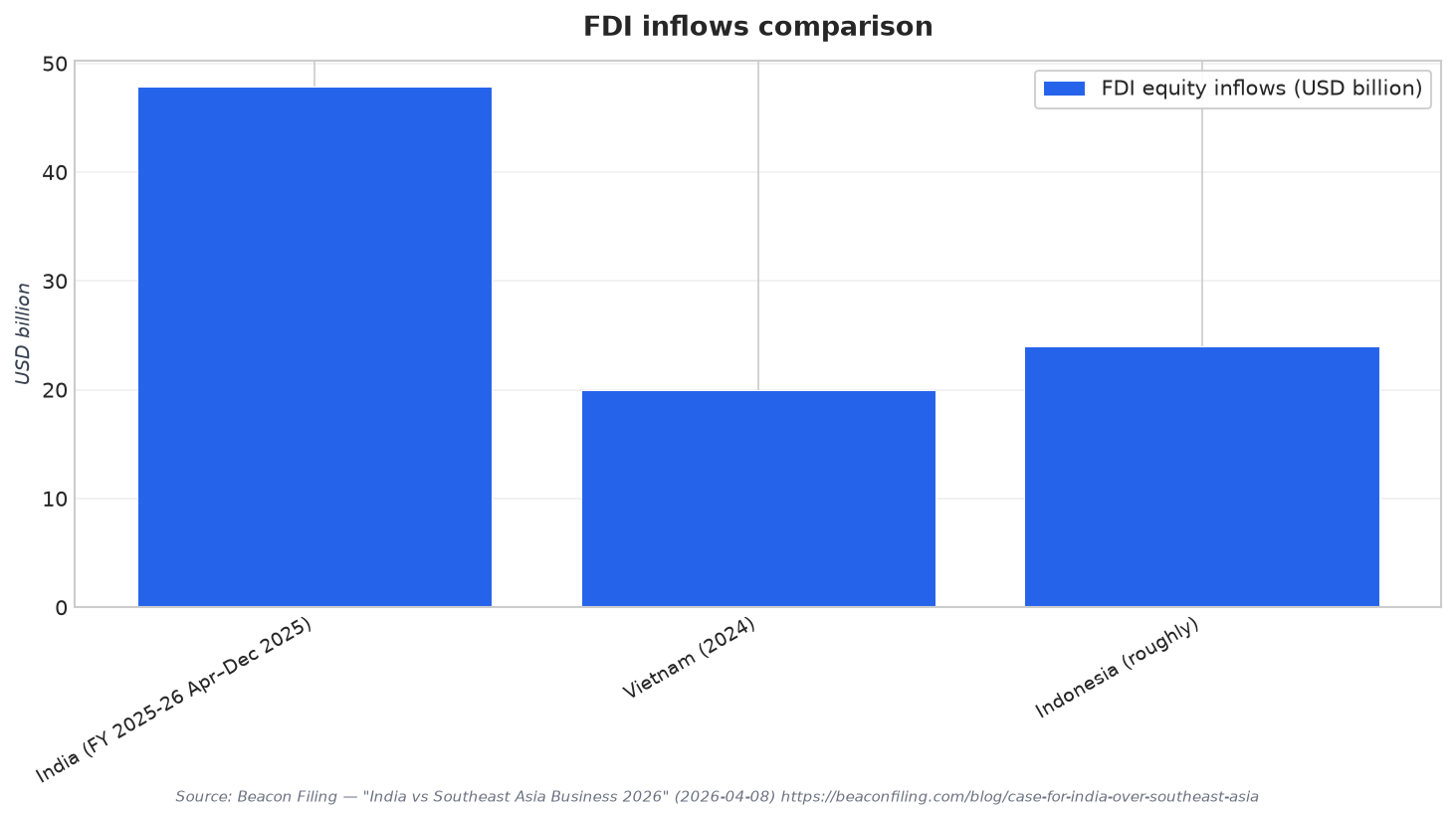
Investment figures help explain why ASEAN and India both stay on the shortlist. UNCTAD figures cited by IMARC Engineering say ASEAN attracted a record USD 225 billion in FDI in 2024, supported by firms diversifying supply chains. At the country level, Beacon Filing reports India drew FDI equity inflows of USD 47.87 billion in FY 2025-26 (April-December 2025), up 22% year-on-year. In the same comparison, Vietnam received approximately USD 20 billion in 2024, and Indonesia roughly USD 24 billion. For supply-chain strategy, these flows translate into capacity additions that are often phased rather than instantaneous, because supply-chain depth takes years to build.
The “other plus one” in 2026 is the operational bridge between India and ASEAN rather than a winner-takes-all choice. One argument is that India is unlikely to displace China as ASEAN’s primary economic partner based on market size, investment volume, or tariff concessions, but it can still support an Indo-ASEAN industrial mini-bloc through soft-power assets, diaspora networks, and digital public infrastructure. In parallel, AMRO emphasizes that ASEAN+3 now accounts for 28 percent of global final demand, surpassing the United States, and that China’s role is central both as production hub and as final demand. For firms, the pragmatic play is to design workflows that connect Indian capabilities with ASEAN manufacturing nodes while staying aligned to where end-market demand is pulling.
How has India-ASEAN trade changed over the past decade?
What does the 2023–24 India-ASEAN trade balance show for supply chains?
Why are companies redesigning the India ASEAN trade supply chain in 2026 instead of simply relocating?
What investment signals are pushing ASEAN and India into “plus-one” planning?
How does regional demand shape supply-chain decisions in 2026?