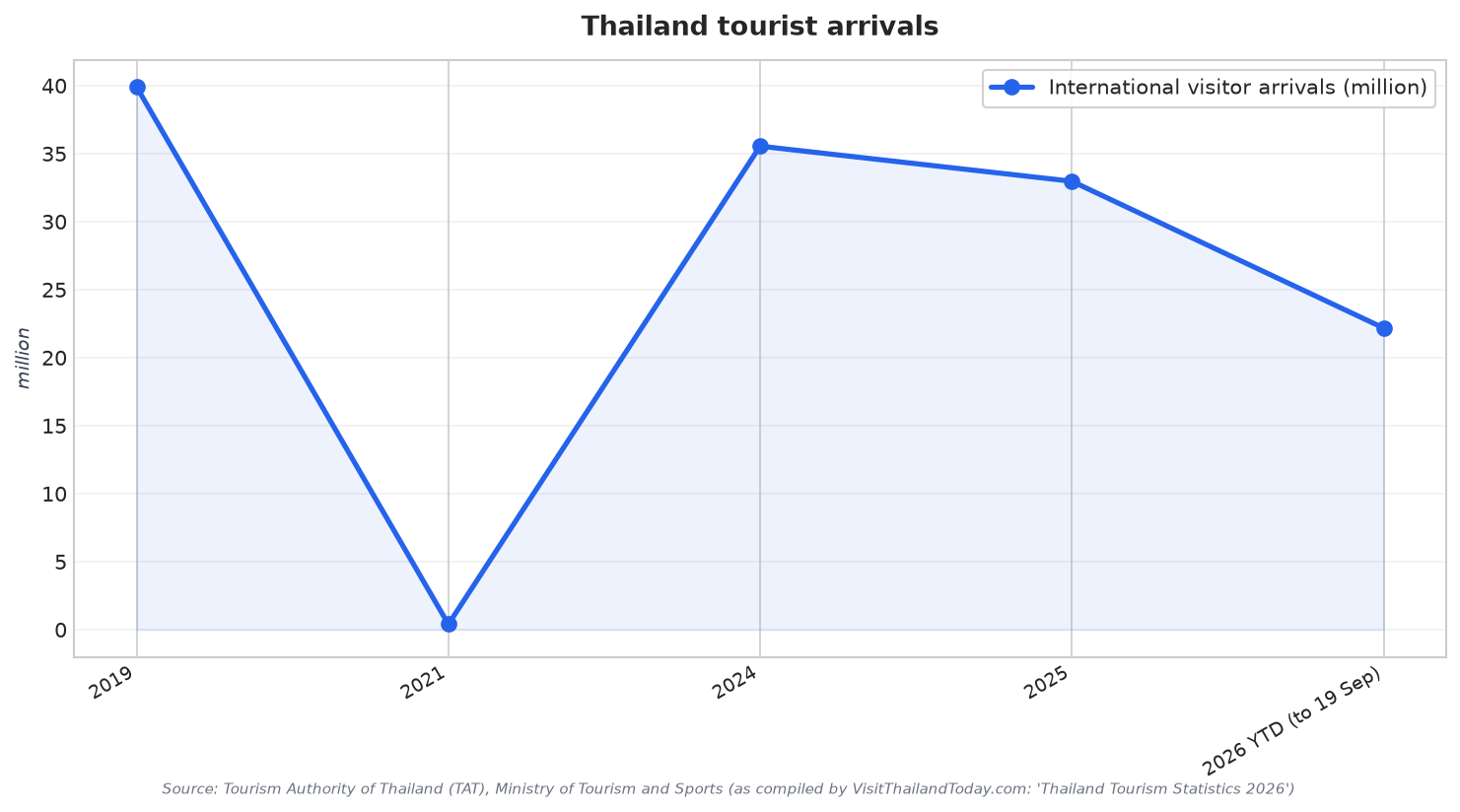
Thailand’s tourism rebound in 2026 is not a straight line, and that matters for investors with exposure to hotels, airlines, retail, and attractions. Official tracking shows 22.18 million international visitors through 19 September 2026, down 3.67% year-on-year, with reported earnings of ฿1.083 trillion. Another official snapshot puts arrivals at 22,666,429 between January 1 and September 26, generating about ฿1.105 trillion, a 3.65% contraction versus the same period in 2025. The Tourism Authority of Thailand (TAT) expects 32.6–32.7 million visitors in 2026, roughly flat on 2025’s 32.97 million.
Where the momentum is clearer is China, now back as Thailand’s biggest source market. In the first eight months of 2026, Chinese arrivals rose 16.05% year-on-year to 3.54 million, which was enough to reclaim the number-one spot after Malaysia led through 2025. A separate late-September tally lists 3,822,928 Chinese visitors year-to-date, with Malaysia at 2,891,908, India at 1,680,725, Russia at 1,249,801, and South Korea at 831,716. For investors assessing the Thailand Chinese tourist arrivals recovery 2026, the key point is that the lead market is improving even as the total visitor count is softer.
What “Uneven Recovery” Looks Like in the Data
The unevenness shows up in the declines among other major markets, creating a push-pull effect on occupancy and pricing power. For January–August 2026, Malaysia fell 11.87% to 2.66 million, and South Korea dropped 24.78%, described as the steepest decline among major markets in that period. The broader narrative in 2026 is that China’s return is supporting the recovery, but Thailand still depends on wider global demand, connectivity, and sustained growth across multiple markets. Even among top sources, only a limited group is growing: one dataset notes the US, Taiwan, and China as the only top-10 markets showing increases.
Investors should also price in the “why” behind the wobble. Commentary on 2026 points to slower recovery in some Asian source markets, confidence and safety concerns, travel costs, air connectivity, and stronger competition from other Asian destinations. There were also operational disruptions: heavy flooding in Bangkok created road delays and staffing shortages for ground handlers at Suvarnabhumi Airport (BKK), leading to temporary luggage processing backlogs. These factors do not negate Chinese demand, but they can cap how much a single source market can lift the full system, especially during peak travel windows.
Into the final quarter, the numbers turn the investment question into one of execution. To reach a revised goal of 33 million visitors, Thailand would need about 10.33 million additional arrivals before December 31, 2026, or roughly 108,000 daily arrivals, versus an estimated year-to-date average near 84,000. Golden Week was framed as a potential catalyst, with projections of 250,000 Chinese visitors and ฿11.5 billion in spending during Sept 25–Oct 7, alongside a reported 42.6% surge in weekly Chinese arrivals. For 2026 and into 2027 planning, investors may focus less on “Is China back?” and more on whether demand broadens beyond China while Thailand maintains operational reliability and market confidence.
What do 2026 figures show about Thailand’s overall tourism pace?
How strong is the China-led rebound in 2026?
Which major markets are weakening while China improves?
What does the Thailand Chinese tourist arrivals recovery 2026 mean for investor expectations?
How much additional volume would Thailand need to hit a 33 million target in 2026?