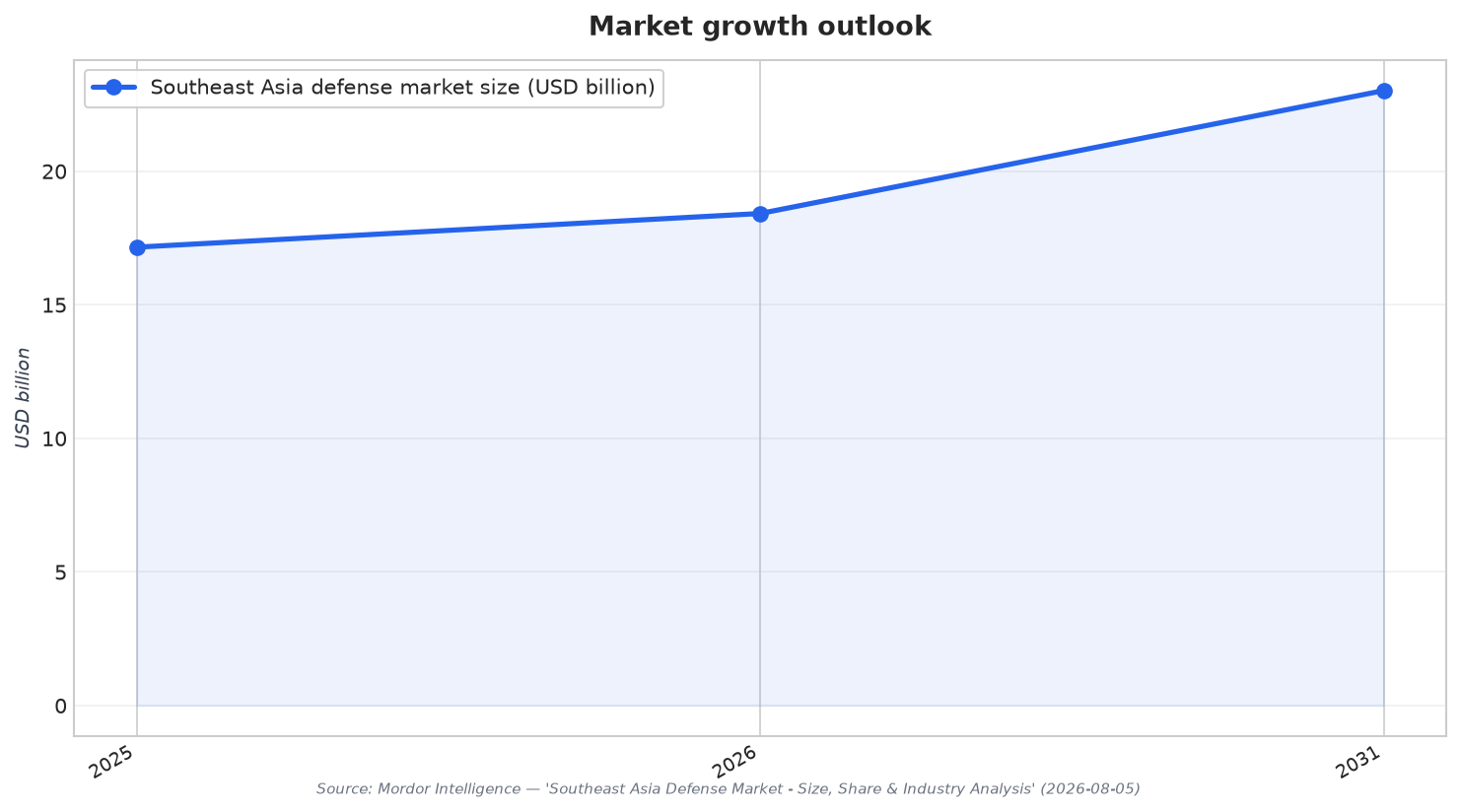
Southeast Asia’s defense market is projected by Mordor Intelligence to grow from USD 17.16 billion in 2025 to USD 18.42 billion in 2026, with a forecast to reach USD 23.02 billion by 2031 (4.56% CAGR over 2026–2031). That spending arc frames why Southeast Asia defense procurement modernization for 2026 matters to B2B suppliers. The same source links demand to escalating gray-zone incidents, joint procurement initiatives, and widening technology-transfer clauses. Acquisition priorities are tilting toward network-centric assets, loitering munitions, and integrated air defense systems. For vendors and integrators, it is not only about platforms. It is also about compliance, industrial offsets, and service support that can keep readiness high under budget pressure.
The procurement mix also signals where near-term revenue pools sit. Mordor Intelligence reports that, by armed forces, the army led with 48.87% of Southeast Asia’s defense market share in 2025, while the air force is projected to expand at a 5.29% CAGR through 2031. By type, vehicles accounted for 42.87% in 2025, but unmanned systems are expected to grow the fastest at a 6.22% CAGR to 2031. By procurement nature, foreign procurement still represented 53.87% of outlays in 2025, even as indigenous production is forecast to accelerate at a 5.12% CAGR through 2031. That combination increases the value of modular upgrades, local assembly, and tech-transfer packages that reduce delivery risk.
Where B2B Value Is Concentrating in 2026
The pressure point for many programs is speed. Mordor Intelligence says China’s expanded coast-guard patrols have reduced procurement cycles from a decade to just 18 months as frontline states prioritize missiles, maritime-patrol UAVs, and multi-role fighters. The same report notes the Philippine Coast Guard recorded 187 Chinese interference episodes in 2024, a 34% increase over 2023, prompting Manila to fast-track acquisitions including BrahMos shore batteries and Hermes 900 UAVs. For contractors, that compressed timeline elevates suppliers that can deliver proven configurations quickly, field training and sustainment in parallel, and integrate systems into common data links and command-and-control workflows.
Country-level signals reinforce the broader pivot toward long-range force-structure planning. The Diplomat reports that Indonesia unveiled a major increase in defense spending for 2026, while the Philippines approved a multi-year USD 35 billion modernization program. It also reports Indonesia bought two warships from Fincantieri for over USD 1 billion and launched Merah Putih frigates built by PT PAL under license, while PT PAL is preparing to build two Scorpene submarines with Naval Group. These examples show why B2B opportunities are expanding beyond primes into licensed production, shipyard tooling, combat-system integration, MRO, and supplier qualification for local yards and assembly lines.
Singapore offers another view of how modernization budgets can translate into procurement pipelines. A GlobeNewswire release states Singapore allocated USD 19.3 billion to its defense budget in 2026, reflecting a 12% CAGR from 2022 to 2026, and forecasts defense expenditure rising at a 3.9% CAGR to USD 23.3 billion by 2031. The same release highlights modernization and self-sufficiency themes and points to opportunity areas such as UAVs, ammunition, and armored vehicles. For B2B vendors, this reinforces the case for localized supply chains, qualification for defense standards, and long-term support models that match multi-year modernization and RDT&E cycles.
How large is the Southeast Asia defense market expected to be in 2026?
What categories are growing fastest in Southeast Asia’s modernization cycle?
Why does procurement speed matter for Southeast Asia defense procurement modernization in 2026?
What modernization signals stand out for the Philippines and Indonesia?
What is Singapore’s defense budget level in 2026, and what does it imply for suppliers?