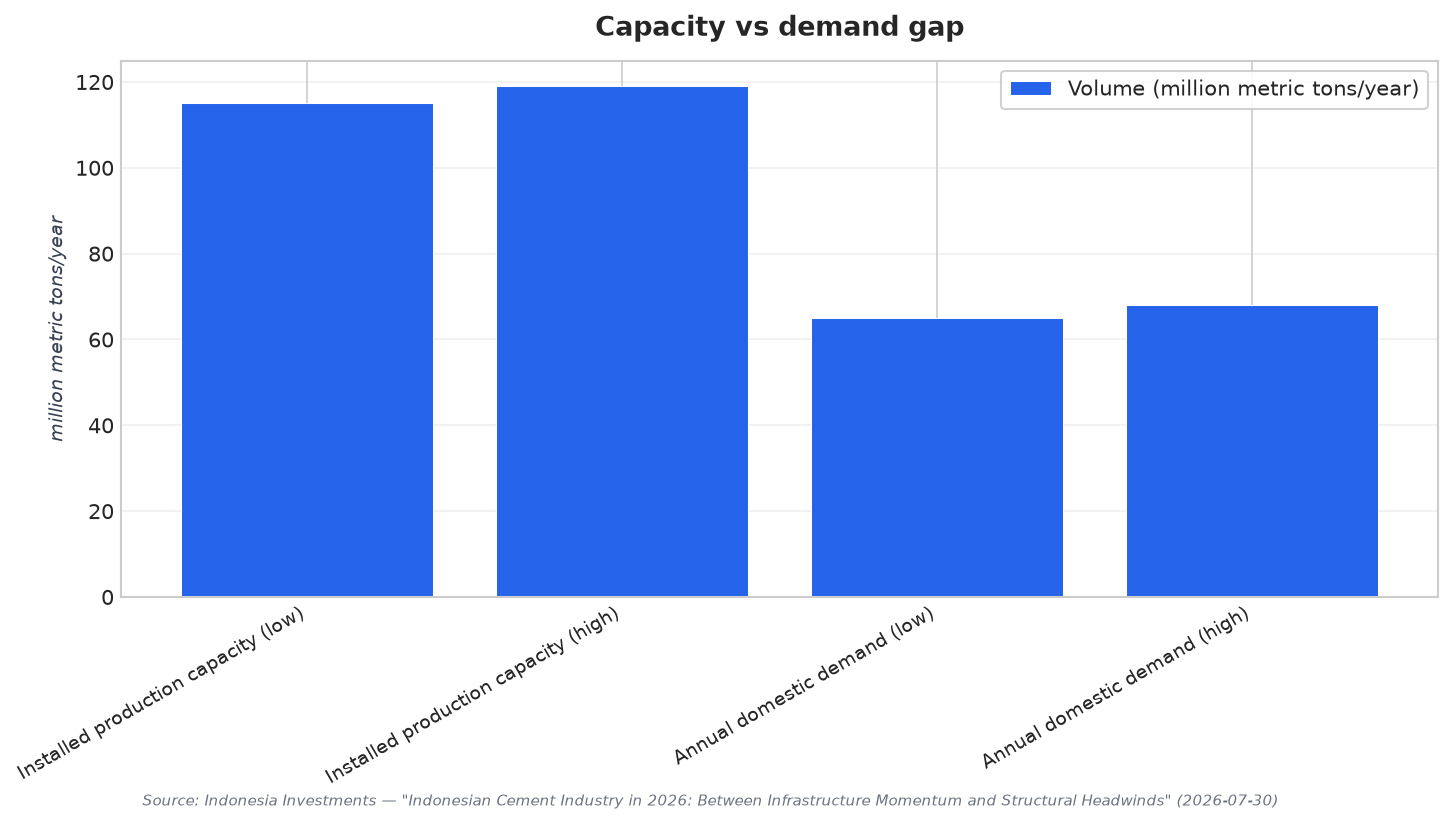
In 2026, Indonesia’s cement story is defined by two forces moving in opposite directions. Demand is getting a lift from government-led projects, yet the industry is still weighed down by too many kilns and too much installed capacity. Analysts describe the market as living under a “severe structural imbalance,” with national installed capacity between 115 and 119 million metric tons per year, while total annual domestic demand ranges from 65 to 68 million tons. That gap keeps utilization around 55-60% and intensifies price competition, setting the stage for consolidation rather than expansion.
The demand catalyst is real and visible in mid-2026 data. Cement consumption surged toward the end of H1/2026, peaking in June 2026 at 5.5 million tons, up 13.1% year-on-year. Bulk cement demand rose 19.9% year-on-year, while bagged cement grew 10.4% year-on-year. The drivers cited include government-backed and social infrastructure initiatives, such as Nutrition Fulfillment Service Units (SPPG) tied to the Free Nutritious Meals program, Red and White Village Cooperatives (KDMP), the People’s School (Sekolah Rakyat) infrastructure program, post-disaster reconstruction in Sumatra, and initial rollouts for a three million houses program.
Why Overcapacity Is Becoming a Consolidation Trigger
Even with stronger offtake, oversupply continues to suppress pricing power and profitability. A 2025 industry report notes that many mid-sized plants are operating at 50-60% capacity, especially in Java, where multiple producers compete for a limited demand base. ESGBusiness estimates overcapacity at more than 56 million tons and argues the market no longer rewards capacity expansion. This is the context for “Indonesia cement overcapacity consolidation 2026” becoming a practical strategy: when utilization is structurally low, scale and integration matter more than adding new lines.
Company results underline both momentum and competitive stress. Semen Indonesia, described as state-controlled and Indonesia’s largest cement producer, sold 18.3 million tons in H1/2026, a 5.6% year-on-year increase, with domestic sales up 9.7% to 14.2 million tons. Indocement Tunggal Prakarsa recorded 8.4 million tons in H1/2026, up 5% year-on-year, but its total market share fell to 28.1% amid competitive shifts across retail and bulk segments. When market share moves in a low-utilization system, the pressure to rationalize assets and pursue combinations tends to rise.
The consolidation logic is reinforced by strategy signals in 2026 commentary. ResearchAndMarkets’ 2026 update highlights a “transition from capacity addition to operational optimisation,” with the Asosiasi Semen Indonesia stressing discipline in production planning amid regional demand disparities. Leading producers are described as focusing on kiln maintenance cycles, procurement optimisation, and supply-chain rationalisation rather than major expansions. To absorb idle capacity, producers also rely on low-margin clinker exports to markets across Southeast Asia, an approach that helps plant loading but does not resolve the core imbalance—making consolidation and tighter operational control a central 2026 theme.
How large is Indonesia’s cement capacity gap in 2026?
What happened to cement consumption in June 2026?
Why does overcapacity encourage consolidation in Indonesia’s cement sector in 2026?
How did Semen Indonesia perform in H1/2026?
What is changing operationally as the industry responds to the imbalance?