

In 2026, a simple question is becoming a line item in B2B contracts: who pays for the packaging after the customer is done with it? Extended Producer Responsibility policies shift the financial and operational burden of packaging waste away from municipalities and back to producers and brand owners that place packaging on the market. In practice, this means fees and obligations tied to the weight, material type, and recyclability of what a brand sells. For procurement teams, EPR adds a new layer of cost analysis, because compliance can require registration with Producer Responsibility Organizations (PROs), packaging data reporting, and payments that vary by the packaging choices a supplier makes.
The compliance challenge is also structural. Sustainability Atlas describes a fragmented Southeast Asian landscape where each country adopts its own definitions of “producer,” “packaging,” and “recovery,” making unified compliance strategies impossible. The same source notes that the ten ASEAN member states collectively generate over 300 million tonnes of municipal solid waste annually, while facing acute plastic pollution challenges. It also points to a clear regulatory trajectory: all major ASEAN economies will have mandatory EPR frameworks by 2028, but the near-term reality is uneven execution and different reporting requirements, fee structures, and timelines across markets.
What Changed in 2026: From Policy to Cost Drivers
Several 2026 milestones make EPR feel less theoretical for B2B brands. Circular Wire reports that Vietnam’s Decree 110/2026/ND-CP has been in force since May 2026, adding detailed recycling requirements that give Vietnam’s EPR framework “operational teeth.” Under Vietnam’s system, producers and importers must either organize the collection and recycling of packaging waste or pay into the Vietnam Environmental Protection Fund. Circular Wire also notes that packaging design choices matter financially, because packaging engineered for recyclability reduces both waste volumes and exposure under the scheme. In Singapore, the Resource Sustainability Act requires companies to report packaging data and submit Reduce, Reuse, Recycle (3R) plans to the National Environment Agency, creating a measurement-first compliance layer that affects supplier documentation.
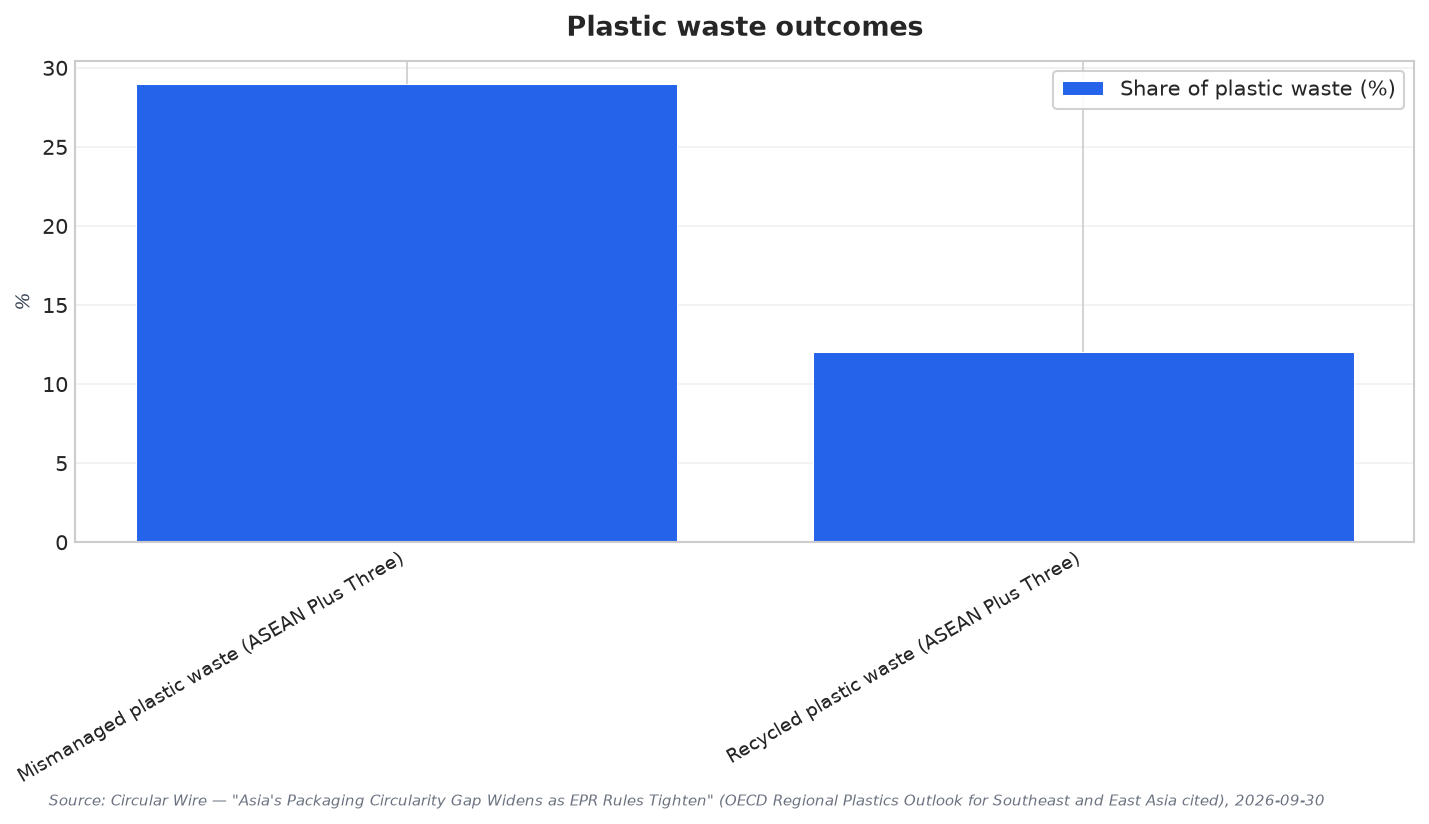
For plastic packaging specifically, the underlying waste gap explains why rules are tightening. Across the ASEAN Plus Three region, mismanaged plastic waste averages 29% and is more than double the 12% that is actually recycled, according to the OECD, as cited by Circular Wire. The same article states that packaging accounts for roughly 40% of plastic use in Southeast Asia, making it the region’s largest plastic application. Sustainability Atlas highlights the implementation gap in Indonesia: Government Regulation No. 27 of 2020 requires packaging producers to recover 30% of their products by 2029, yet compliance rates remained below 5% as of mid-2025, according to the Indonesian Packaging Recovery Organization (IPRO). For B2B brands, this mismatch can translate into more audits, more proof requirements, and more volatile compliance pathways.
These regulatory pressures are landing in a market that is still growing. MarkWide Research values the ASEAN flexible packaging market at $18.7 Billion in 2026 and forecasts it to reach $33.81 Billion by 2035, progressing at a 6.80% CAGR. In that context, the practical impact of ASEAN EPR plastic packaging regulation is not only new fees but also earlier-stage scrutiny: MarkWide reports that, in Singapore, converters must submit recyclability disclosures to the National Environment Agency prior to product launch. For B2B brands buying films, pouches, or mailers, the winning procurement posture in 2026 is to treat packaging specs, reporting readiness, and end-of-life responsibility as part of supplier qualification, not an afterthought.
What does Extended Producer Responsibility mean for who pays for packaging in 2026?
Why is compliance so complex across Southeast Asia?
What changed in Vietnam’s packaging EPR rules in 2026?
What do the OECD figures imply for ASEAN EPR plastic packaging regulation priorities?
What is one documented compliance gap that affects B2B planning in Indonesia?