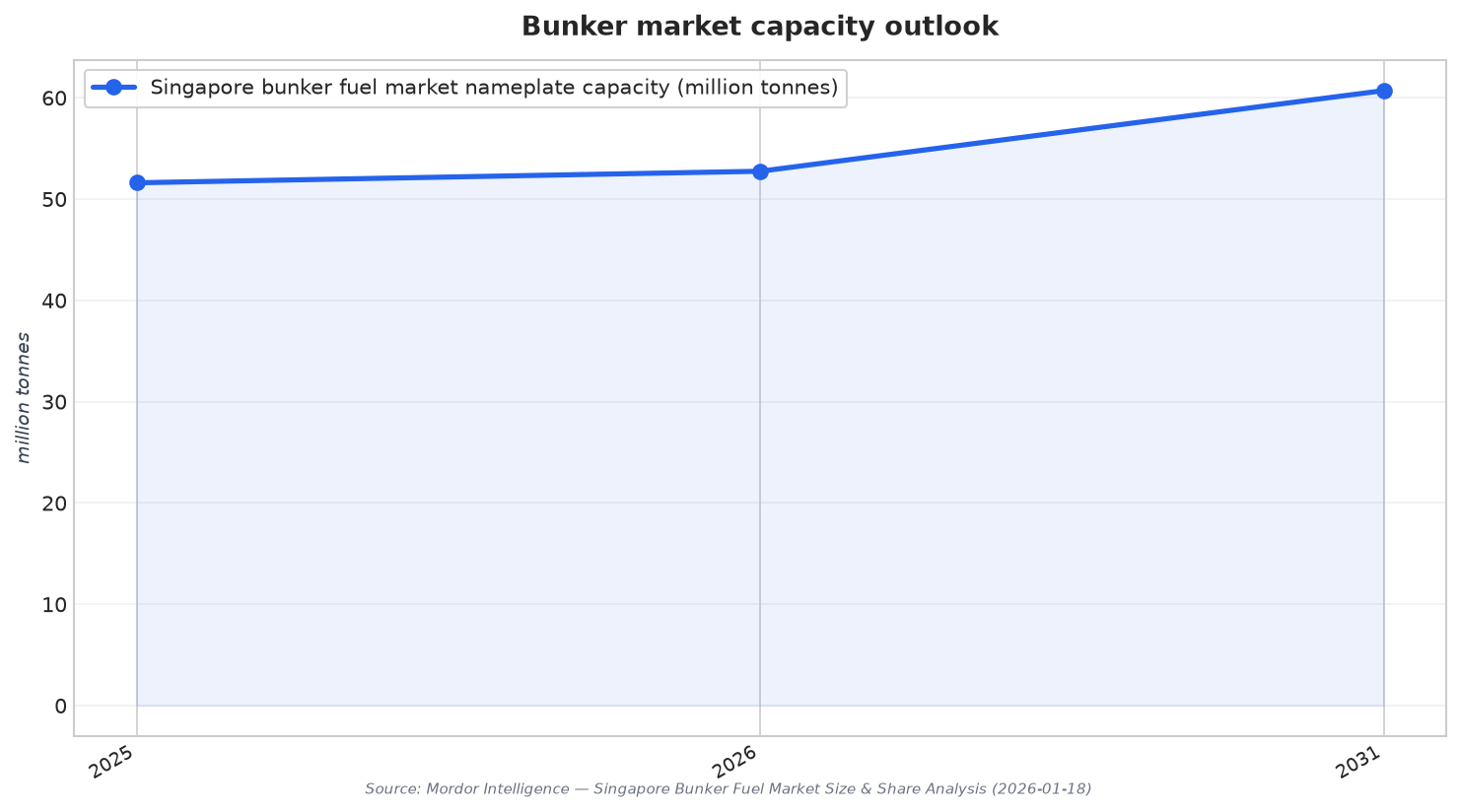
Singapore is entering 2026 with a clear advantage: scale, reliability, and a playbook built for compliance-led change. Singapore’s bunker fuel market nameplate capacity is projected at 52.75 million tonnes in 2026, up from 51.61 million tons in 2025, with Mordor Intelligence forecasting 60.71 million tonnes by 2031 at a 2.85% CAGR from 2026 to 2031. Demand has also been resilient at the port level. Singapore recorded 54.92 MT of bunker sales in 2024, and separate reporting puts marine fuel sales at 56.77 million tonnes in 2025, a 3.4% increase from 2024.
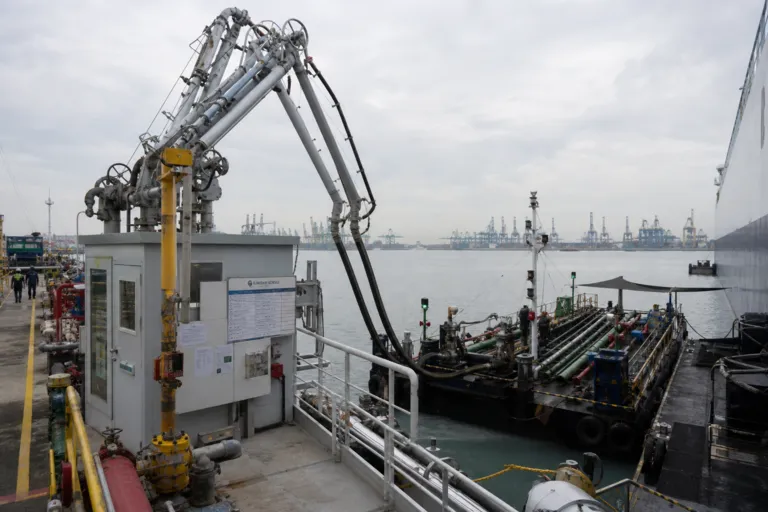
Part of Singapore’s near-term demand story is operational, not just structural. Mordor Intelligence notes 2024 bunker sales were lifted by Red Sea conflict diversions that routed Far East–Europe traffic around the Cape of Good Hope, adding roughly 8,500 nautical miles per voyage and increasing fuel demand. But the longer arc is about modernizing how bunkers are sold, verified, and regulated as the fuel mix changes. Mandatory electronic bunker delivery notes (eBDNs) were introduced in April 2025, reducing information asymmetry and narrowing bid-ask spreads. The Maritime and Port Authority of Singapore also enforces bunker licensing and mass flow meter mandates, while the National Environment Agency monitors air quality impacts from bunkering operations, adding compliance costs that flow through pricing.
Why Singapore’s 2026 Strategy Focuses on Multi-fuel Readiness
The fuel transition is happening while conventional grades still dominate volumes. In 2025, VLSFO held a 55.3% share of the Singapore bunker fuel market, showing how IMO-aligned compliance demand anchors daily procurement. Yet the same market is already positioning for alternatives. Mordor Intelligence describes government incentives catalyzing LNG, methanol, and biofuel uptake, and highlights Maersk’s successful 2023 ship-to-ship methanol bunkering in Singapore as a proof point. This matters because price-sensitive switching still exists. HSFO consumption can revive when the HSFO–VLSFO spread exceeds USD 150 per ton, illustrating why Singapore is building optionality rather than betting on one fuel pathway.
In 2026, that optionality increasingly includes ammonia preparedness, even as the infrastructure challenge is acknowledged. MarkWide Research flags an “ammonia infrastructure gap” and notes that zero-carbon ammonia bunkering requires specialized storage and handling, while stakeholders monitor ammonia and methanol pilot projects to guide capital commitments. A September 2026 market update also states Singapore’s strategy explicitly includes methanol, LNG, biofuels, and future ammonia infrastructure, with the port expanding methanol, LNG, and biofuel capabilities rather than replacing conventional bunkering. For global context, IMARC notes alternative fuel infrastructure remains concentrated at fewer than 50 ports globally, strengthening the case for major hubs to lead.
Singapore’s push is also reinforced by the direction of global policy and market design. DataM Intelligence reports the IMO’s Net-Zero Framework approved at MEPC 83 in April 2025 introduces a new fuel standard and a global GHG pricing mechanism for large ocean-going ships above 5,000 gross tonnage, which account for around 85% of international shipping CO2 emissions. That backdrop helps explain why the keyword topic—Singapore green marine fuel bunkering 2026—centers on readiness and supply certainty. Singapore reported more than 28 million tonnes of bunker sales in the first half of 2026, following the record 56.77 million tonnes in 2025, signaling that the port is scaling alternative fuel capability while still serving large conventional demand.
What is driving Singapore’s green marine fuel bunkering push in 2026?
How large is Singapore’s bunker market in 2026 by projected capacity?
What were Singapore’s recent bunker sales figures leading into 2026?
How dominant is VLSFO in Singapore’s bunker mix today?
Why is ammonia bunkering described as harder to implement than other alternatives?