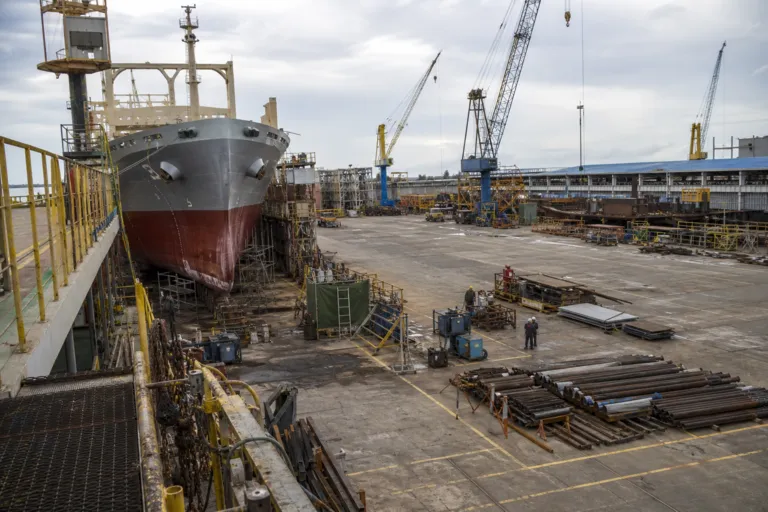
Full order books are back in the conversation in 2026, and they are reshaping how owners, yards, and suppliers think about risk and capacity. At SMM 2026 in Hamburg, Seatrade Maritime reports an orderbook that is almost one third larger than the last time Hamburg Messe opened its doors to the industry, reinforcing the idea that demand has not faded. The same report frames this as a strong outlook for equipment and technology providers, even while competition for industrial value is shifting. For Southeast Asia, the signal is clear: when global backlogs stay elevated, repair slots, retrofit work, and overflow construction become more contested, and regional yards get a fresh chance to win work.
Geopolitics is a key reason the cycle has not cooled as much as some expected. The Diplomat notes that the 2026 war between Iran, the United States, and Israel caused a spike in demand for alternative suppliers and routes, prompting Fitch Rating to revise its sectoral outlook to “neutral” from “deteriorating.” It also cites Container Trades Statistics showing global container volumes hit 16.2 million TEUs in April, the first full month of data after Strait of Hormuz closures triggered by February’s Persian Gulf crisis, up 4% year over year and 1.6% over March. Year-to-date volumes were running 5% ahead of 2025. In that environment, orderbooks are increasingly treated as insurance rather than oversupply.
Why Southeast Asia’s Yards Are Getting a Second Look in 2026
The Southeast Asia shipbuilding repair industry 2026 story is not only about demand. It is also about organization and capability-building. The Diplomat reports that at the OECD–Southeast Asia Policy Roundtable on Shipbuilding, Steel, and AI in Tokyo in February 2026, Indonesia, Vietnam, and Thailand agreed to a regional peer review with the OECD covering workforce skills, technical capabilities, supply chain dependencies, energy-efficient ships, and leveling the competitive playing field. The Philippines separately agreed to follow up on implementation pathways for OECD peer review recommendations. All four countries were invited to join the OECD shipbuilding committee meeting in Paris in April, creating a structured pathway for improvement rather than ad hoc development.
At the same time, the regional growth expectations being discussed for Southeast Asia are meaningful. Worldmetrics’ “Shipbuilding Marine Industry Statistics 2026” states that shipbuilding demand in Southeast Asia is expected to grow by 8% annually from 2023 to 2032, driven by infrastructure projects. This intersects with a repair and retrofit reality: IndexBox’s Asia-Pacific shipbuilding adhesives report expects the MRO segment to grow steadily, supported by an aging global fleet and compliance requirements that necessitate specialized adhesives for repairs and retrofits. It also projects Southeast Asia’s share of regional demand for shipbuilding adhesives will rise from an estimated 10–12% in 2026 to 17–20% by 2035, pointing to a wider supplier footprint that repair yards can draw on.
Competition remains intense, and Southeast Asia’s revival is quiet because it happens in the shadow of larger players’ scale. Xinde Maritime News reports that a Chinese yard secured 207 vessels in the first half of 2026, and that South Korean yards ranked second, securing 195 vessels and about 8 million CGT, around 19% of the global market. It adds that many top-tier yards are already booked into 2029 or 2030, making delivery availability almost as important as price. That dynamic matters for Southeast Asia because repair, conversion, and supplier-enabled upgrades can be a practical release valve when prime newbuilding slots are scarce and owners need near-term solutions.
What is driving the stronger orderbook backdrop in 2026?
What container-trade signal did sources cite after the Strait of Hormuz closures?
How are Southeast Asian governments coordinating on shipbuilding capability in 2026?
What growth expectation is cited for Southeast Asia shipbuilding demand?
What does the Southeast Asia shipbuilding repair industry in 2026 have to do with adhesives and MRO?