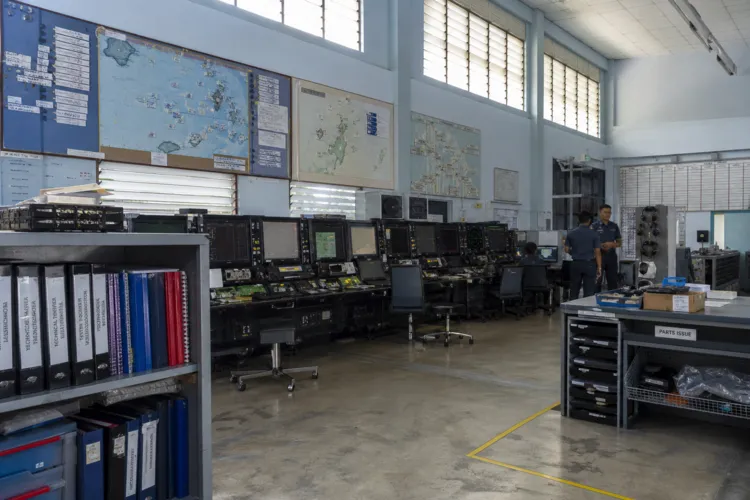
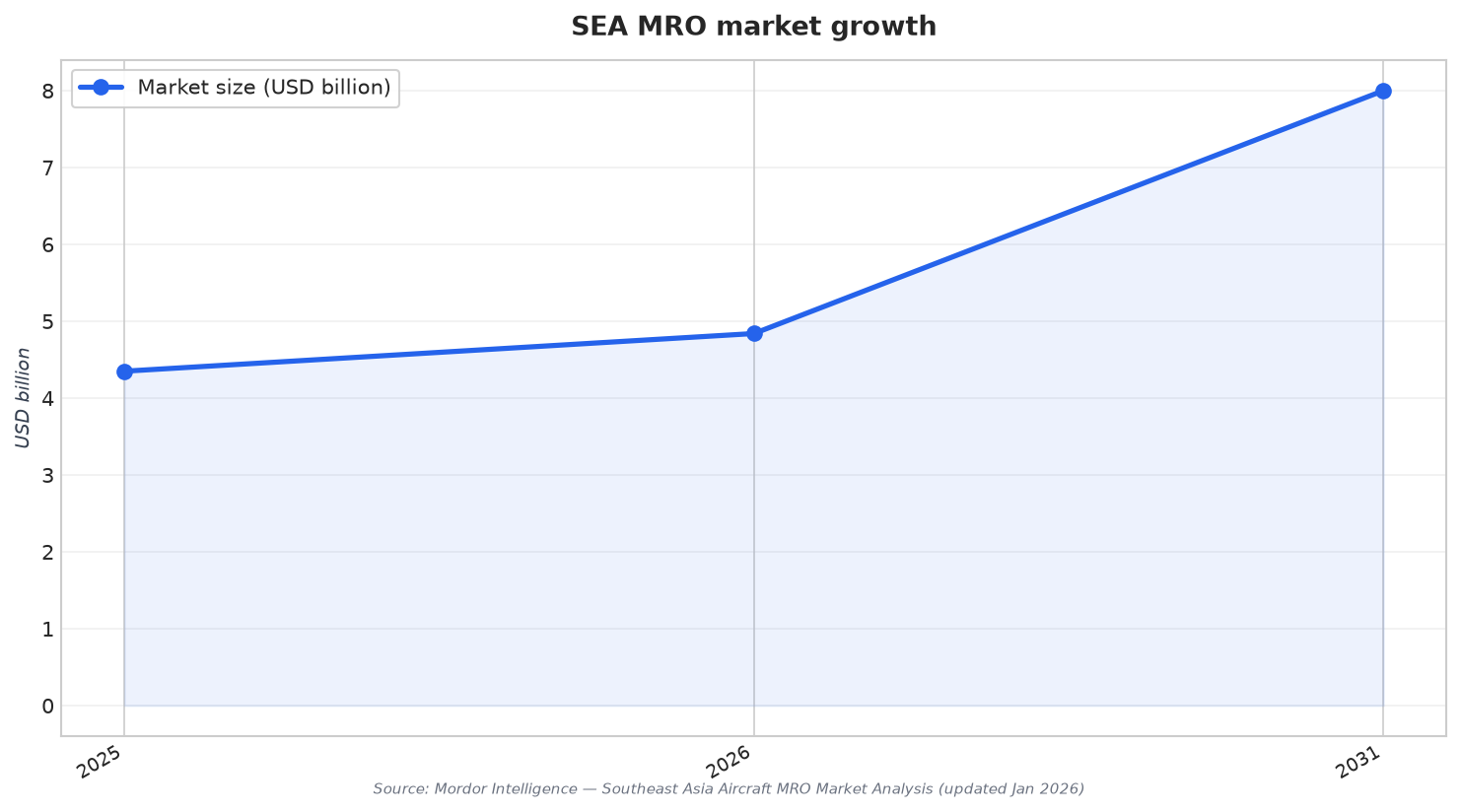
Southeast Asia’s aircraft MRO market is expanding into 2026, but the region is also running into a capacity squeeze that is showing up in turn times, inventory behavior, and rising costs. Mordor Intelligence expects the Southeast Asia aircraft MRO market to grow from USD 4.35 billion in 2025 to USD 4.84 billion in 2026, with a longer-run forecast to USD 8.00 billion by 2031 at a 10.58% CAGR over 2026–2031. In 2025, fixed-wing platforms made up 92.56% of spend, and commercial passenger fleets contributed 68.93% of revenue, which means the highest-volume operators are the ones most exposed when capacity tightens. Engine work is the center of gravity too, holding 45.74% share of the 2025 market.
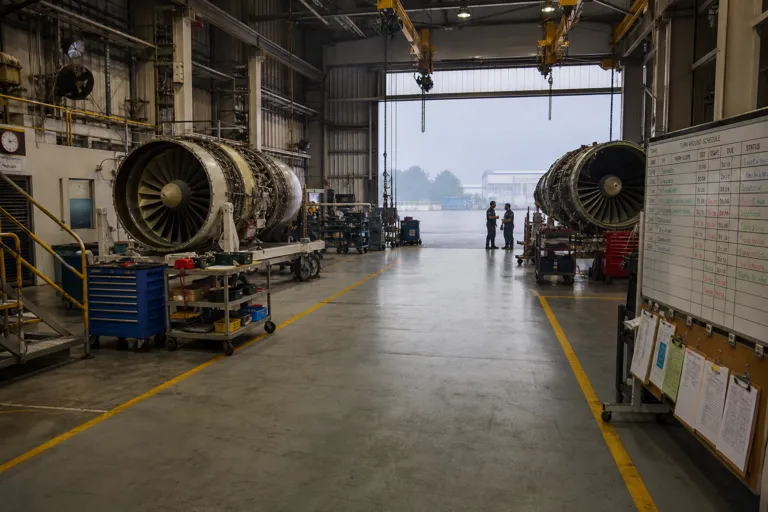
The crunch is not abstract. Mordor Intelligence cites shop-visit turnaround times that exceed 300 days, while high-pressure turbine (HPT) blade shortages are forcing operators to lease spare engines for up to USD 1.2 million per month. Verified Market Research adds that issues with GE Aerospace’s LEAP engines and Pratt & Whitney’s GTF engines have led to a surge in “Aircraft on Ground” (AOG) incidents across Indonesia and the Philippines, pushing airlines to hold 20–30% more safety stock than in 2019. In parallel, Mordor’s Asia-Pacific MRO report flags a 15–20% rise in labor, parts, and logistics costs, compounding the economics of every delay and making guaranteed turnaround performance a pricing lever.
Where the 2026 B2B Opening Is Forming
The clearest opening is capacity relief that can be sold B2B: more bays, faster cycles, and fewer unscheduled removals. Mordor Intelligence notes that predictive analytics can trim unscheduled removals by almost one-fifth in Southeast Asia, effectively freeing scarce bay capacity without building new hangars overnight. In the wider Asia-Pacific context, the same firm points to predictive-maintenance platforms that can reduce unscheduled events by up to 30%. These figures turn data and reliability into a capacity product, not just an IT upgrade. They also align with the region’s response pattern: airlines are expanding in-house maintenance wings, and governments are competing with single-digit tax regimes to attract new hangar, test-cell, and component-repair investment.
Components and modifications also look structurally supported, especially when engine bottlenecks push operators to seek parallel paths to availability. In Southeast Asia, component repair is forecast by Mordor Intelligence to grow at a 12.25% CAGR through 2031, while independent providers are forecast to grow at an 11.65% CAGR through 2031 by focusing on component repairs and freighter conversions. Mordor also highlights that freighter conversions add an extra 12–18 heavy-check events per airframe, increasing maintenance events that must be scheduled into limited bay capacity. On the geographic side, Singapore led Southeast Asia with 33.25% of 2025 revenue, while Thailand is projected to grow at 12.11% CAGR through 2031, linked to the USD 12 billion U-Tapao Aviation City scheme.
For vendors planning around Southeast Asia aircraft MRO capacity in 2026, the near-term advantage comes from selling certainty: access to bays, parts availability, and turnaround commitments that withstand supply volatility. GE Aerospace is spending USD 75 million to double LEAP maintenance throughput in Malaysia and Singapore and to install two new test cells by 2027, while Mordor reports that ST Engineering obtained the first independent LEAP certification in Southeast Asia, positioning Seletar as a neutral hub for more than 500 annual shop visits. But the same source warns that specialized tooling and 18–24 months of technician retraining are required, which keeps human-capital capacity tight. In that context, B2B offerings that reduce removals, improve component flow, or package retrofit work alongside checks can monetize the gap between demand growth and constrained throughput.
What is driving the Southeast Asia aircraft MRO capacity crunch in 2026?
How big is the Southeast Asia aircraft MRO market in 2026?
Which MRO work types look most exposed to capacity constraints?
How can predictive maintenance ease capacity pressure?
Where are the strongest hub signals inside Southeast Asia for MRO demand?