
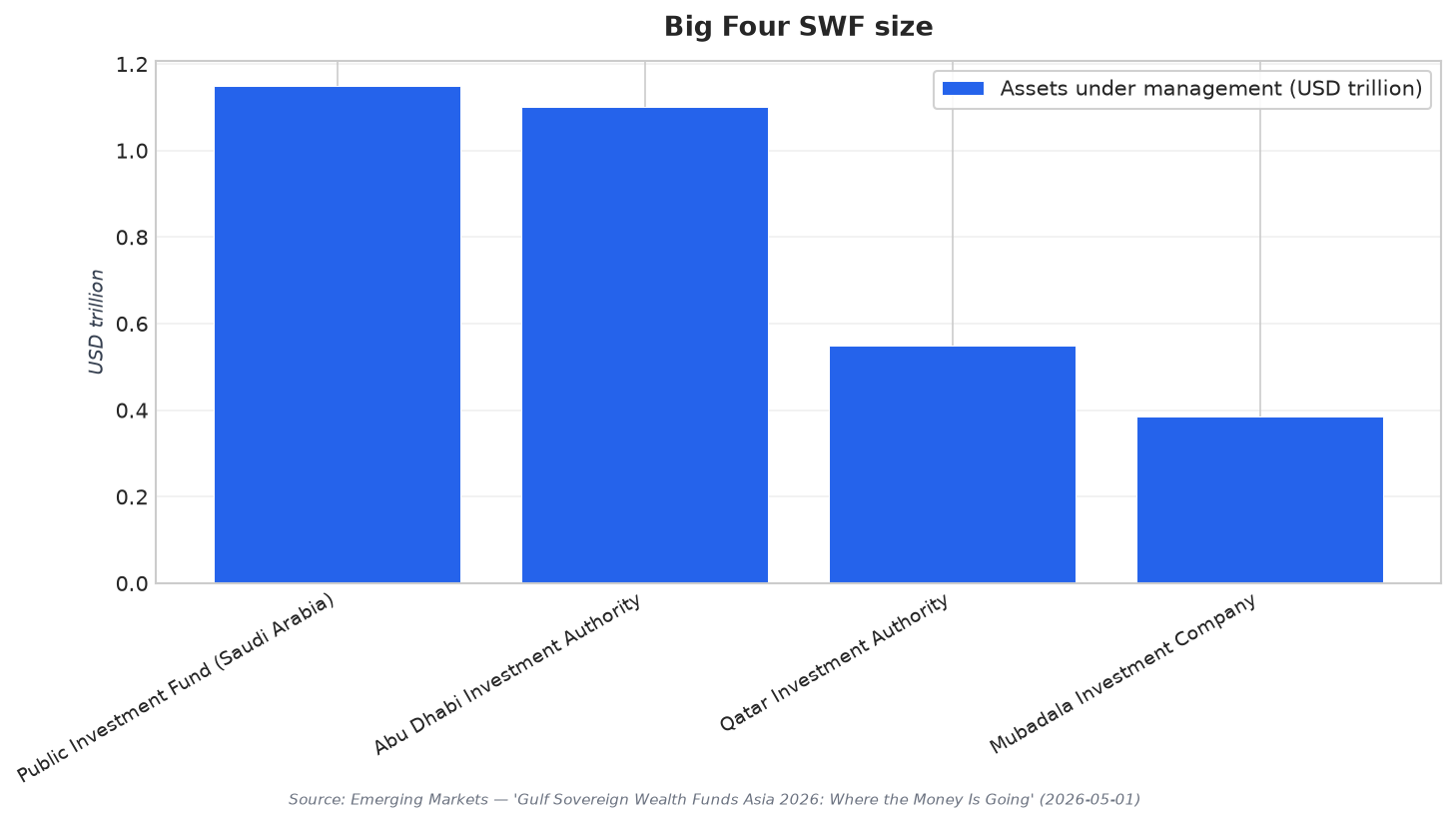
In 2026, the story of Gulf money moving east is less about headlines and more about patient capital changing deal mechanics. The four largest Gulf sovereign wealth funds sit on a combined US$3.2 trillion, based on figures updated through 2025 annual reports. They are built for 20-to-50-year horizons, and that time frame matters in infrastructure, where greenfield development and long-lived operating assets can match the duration of sovereign portfolios. Asia is central to that repositioning, with their Asia allocation estimated at 30–40% of total assets, a shift that has accelerated since 2020. For Southeast Asia, this sets the stage for more partnership-led capital, more selective underwriting, and greater focus on assets that can absorb volatility without forcing exits.
The Gulf’s eastward focus is also reinforced by trade gravity. Recent data indicate that around 80% of seaborne crude oil exports from Gulf states and OPEC now go to Asia, and Asia came to source nearly 60% of its oil needs from the Middle East. This commercial reality is paired with a broader expansion in Gulf-Asia trade: Asia House estimates Gulf-Asia trade could exceed $802bn by 2030, based on current growth rates, and Asia is expected to become the Gulf’s leading trading partner by 2028. China-GCC trade reached $257bn in 2024 and is expected to rise to $375bn by 2028. Even when these figures are not ASEAN-specific, they explain why infrastructure investors frame the eastward pivot as strategic, not opportunistic.
Why 2026 Infrastructure Deals Favor Partnerships Over Pure M&A
Deal structure is shifting alongside capital direction. PwC’s H1-2026 view of the Middle East shows that, amid geopolitical uncertainty, the largest mid-year transactions concentrated around utilities, power, and operating infrastructure, explicitly because they generate predictable cash flows and carry clear strategic value. The same update notes that some of the half’s largest digital investments progressed through partnerships, infrastructure investment, and greenfield development rather than traditional acquisitions. Examples of operating-infrastructure transactions include ADNOC Drilling’s acquisition of 80% of Oman’s MB Petroleum Services for US$204 million, and Aldar’s US$177 million acquisition of an industrial and logistics portfolio from AD Ports Group, alongside Mair Group’s purchase of associated warehouse assets for US$80.3 million. These reference points matter because they illustrate how cash-flow certainty and control rights are being priced in 2026.
Global managers are also wiring the Gulf into cross-regional infrastructure capital, which can accelerate outbound appetite when domestic deployment faces constraints. ION Analytics highlights a USD 30bn investment vehicle announced in May between BlackRock’s Global Infrastructure Partners, ADNOC, Abu Dhabi’s L’imad, and Singapore’s Temasek. In parallel, Macquarie Asset Management signed a preliminary agreement with Saudi Arabia’s PIF to invest and collaborate in infrastructure and energy transition sectors, including electric vehicle and battery storage infrastructure, and it is leading a consortium planning to bid for a contract to develop, finance, and operate the first high-speed urban rail in Riyadh. These platforms and partnerships shape how capital is packaged, and they influence how ASEAN counterparties may see Gulf-linked capital arrive: via consortia, co-investment, and longer-dated commitments rather than fast, standalone buyouts.
On the receiving side, Southeast Asia’s growth narrative in 2026 is increasingly described in terms of where capital concentrates. Aster of Asia frames ASEAN as a 700M-strong, $4T economy that grows 4.7% in 2026, with visible investment themes ranging from industrial zones in Vietnam to data centers near Bangkok and solar farms in Malaysia’s Johor state. It also notes that buyers from the Middle East and Gulf markets are increasingly treating Phuket as a lifestyle and diversification play alongside Dubai and Singapore. Put together, this is the practical linkage for ASEAN GCC investment capital flows: Gulf investors with long horizons and rising East Asia trade exposure, and ASEAN markets presenting on-the-ground infrastructure and real-asset pathways where partnerships and greenfield development can be as decisive as M&A.
What is driving Gulf capital to look east in 2026?
How do trade patterns support the eastward investment shift?
What types of assets are favored in 2026 infrastructure dealmaking?
Which 2026 examples show how big infrastructure platforms are forming?
How are ASEAN-GCC investment capital flows influencing infrastructure deals in 2026?