Aviation is under rising pressure to decarbonise, and ASEAN is increasingly treating sustainable aviation fuel (SAF) as a practical near-term lever. The ASEAN Centre for Energy (ACE) notes that aviation accounted for 2.5% of global energy-related carbon dioxide emissions in 2023, and the sector remains heavily dependent on liquid fuels due to current battery limitations. This is where Southeast Asia’s SAF push is gaining momentum: it can be blended with conventional jet fuel and used in existing engines and airport infrastructure as a “drop-in fuel,” according to ARC Advisory Group. That compatibility helps explain why governments, airlines, and refiners are building policies and supply chains now, before mandates widen under international rules.
Mandates and compliance timelines are accelerating the shift from pilots to procurement. ACE highlights that under ICAO’s Carbon Offsetting and Reduction Scheme for International Aviation (CORSIA), countries agreed to systematically reduce emissions from international flights, and starting in 2027 the rules will apply more broadly across international routes. Several ASEAN countries are responding with national blending measures. Singapore will require departing flights to use a 1% SAF blend starting this year, scaling to 3–5% by 2030, while Indonesia targets an initial 1% blend in 2027 and a long-term goal of 50% by 2060. Malaysia is aiming for a 47% SAF blending mandate by 2050 as part of a broader target to achieve net-zero aviation emissions by the same year. ACE also projects regional SAF demand rising from 15,000 barrels per day in 2030 to over 700,000 barrels per day by 2050, with Indonesia, Malaysia, and Singapore driving the bulk of consumption.
Feedstock and Projects: Turning Regional Waste Into Jet Fuel
The policy push is colliding with a race to secure sustainable feedstocks and bankable capacity. The ASEAN SAF 2050 Outlook, cited by the ASEAN main portal and Boeing, says ASEAN economies could generate as much as 8.5 million barrels per day of SAF by 2050. S&P Global adds that projected internal demand is expected to exceed 700,000 barrels per day by 2050, while production potential from agricultural and forestry waste remains significantly greater. The report highlights primary feedstocks including rice straw, cassava, and forestry residues, pointing toward a “waste-residue” complex. Cost remains a constraint: the ASEAN outlook states HEFA is the most prevalent technology today and costs about twice as much as jet fuel, with feedstock the largest cost contributor, while Gasification + FT, ATJ, and HTL pathways could be 4–7 times more expensive, though the gap is expected to reduce as technologies mature and scale up.
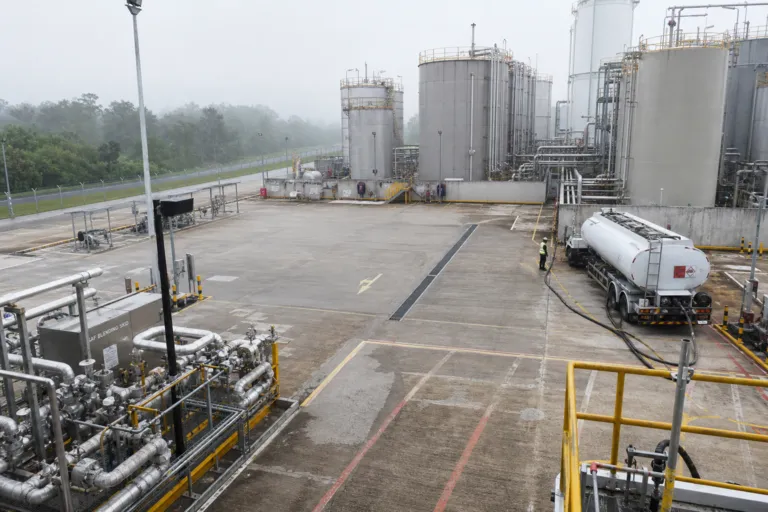
Across the region, the project pipeline is becoming more concrete, with capacity figures that signal intent even as execution risk remains. ARC Advisory Group points to Thailand’s initial commercial deliveries supporting an early blending mandate, with production capacity of about 292,000 tons annually. In Malaysia, the PETRONAS-Enilive-Euglena biorefinery in Pengerang, Johor is under construction, targeting about 650,000 tonnes per year of SAF, HVO, and bio-naphtha, with commercial operations expected in late 2028. In Singapore, Aster includes Project Beacon at demonstration scale (about 2,000 tons per year using biomethane feedstock) and a Jurong Island ethanol-to-jet facility at commercial scale (about 100,000 tons per year) in the FEED stage. ARC also reports Neste has been operational in Singapore since early 2023, producing up to 1 million tons per year from waste and residue feedstocks, while Pertamina has been operational since mid-2025 at the Cilacap refinery, producing SAF partially derived from used cooking oil with deliveries to airports including Soekarno-Hatta.
Commercial agreements and certification steps are beginning to connect supply to airline demand, which is central to making Southeast Asia sustainable aviation fuel SAF credible at scale. ACE notes that Pertamina developed a 2.4% SAF blend and that its refining subsidiary secured CORSIA-aligned International Sustainability and Carbon Certification (ISCC). ACE also reports Petronas signed an agreement with the Malaysia Aviation Group in 2023 to supply over 230,000 tonnes of SAF starting in 2027. In the wider Asia-Pacific context, MarketsandMarkets projects the Asia Pacific SAF market will grow from USD 1,078.6 million in 2026 to USD 7,606 million by 2031 at a 47.8% CAGR, outpacing a stated global growth rate of 45.3%, with China cited as dominating Asia Pacific’s SAF market with a USD 3,141.7 million market size. For ASEAN, the race now is to align mandates, feedstock supply chains, and certified production quickly enough to meet policy deadlines and compete for regional and import-market demand.
What is driving the push for Southeast Asia’s sustainable aviation fuel (SAF)?
What blending mandates have ASEAN countries announced for SAF?
How big could ASEAN’s SAF supply potential be by 2050?
Which feedstocks does the ASEAN SAF 2050 Outlook highlight for Southeast Asia?
What new SAF production capacities are being developed in ASEAN?