
The Busan Trump–Xi meeting and the Kuala Lumpur ASEAN discussions signaled a more complex U.S. tariff environment heading into 2026. In Busan on 30 Oct 2025, President Donald Trump announced that the effective U.S. tariff burden on Chinese goods would be reduced “from about 57% to about 47%,” mainly by cutting the fentanyl-related surcharge from 20% to 10% and pausing certain escalation measures threatened for 1 November. DFDL stresses that this “57% → 47%” is a political headline figure repeated by Reuters and the Guardian, not yet a consolidated line-by-line schedule from CBP or USTR. For ASEAN exporters, that nuance matters because routing, classification, and the specific HTS line still drive the rate paid at entry.
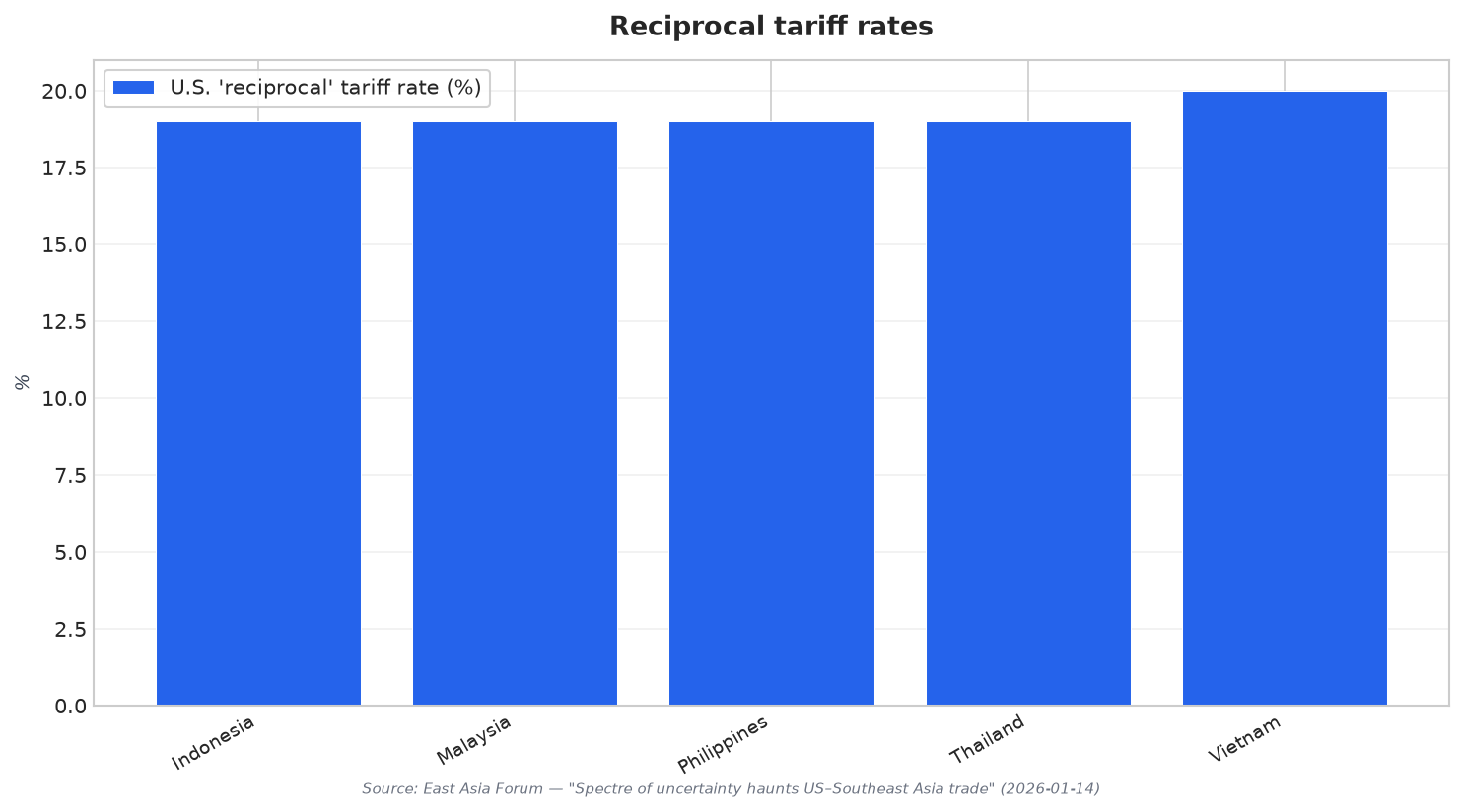
At the same time, the Kuala Lumpur meetings (26–28 Oct 2025) brought more predictability for several ASEAN members. DFDL reports that the U.S. confirmed or initialed “reciprocal tariff frameworks” with Malaysia, Cambodia, Thailand, and Vietnam, broadly aligning them with the 19–20% U.S. reciprocal tariff band that has applied since the July 31 / 7 Aug 2025 tariff modification. East Asia Forum also describes largely uniform reciprocal rates at 19% each for Indonesia, Malaysia, the Philippines, and Thailand, and 20% for Vietnam as 2026 begins. These frameworks may open doors to sectoral carve-outs, but they do not remove the broader reciprocal architecture that firms must plan around.
Why Origin, Not Country Labels, Now Drives Tariff Risk
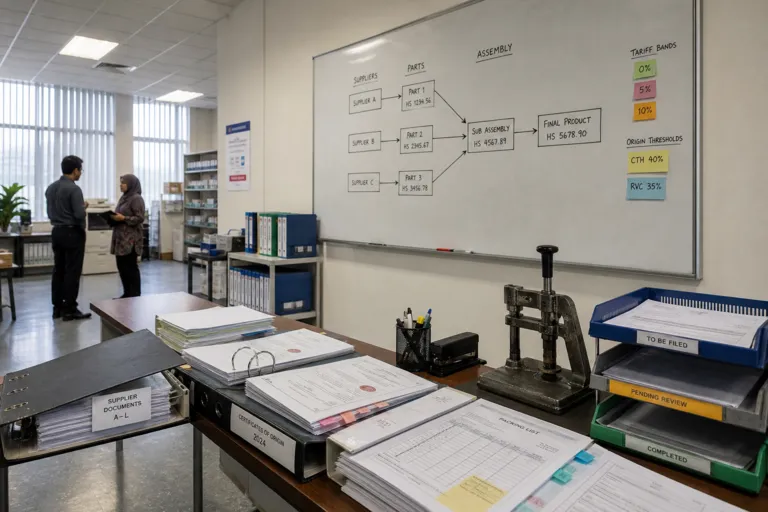
For sourcing decisions, enforcement trends are increasingly decisive. Eurogroup Consulting notes that CBP intensified circumvention probes under the Enforce and Protect Act, with cases involving ASEAN economies rising from 6 in 2021 to 20 in 2024. In April 2025, the U.S. Department of Commerce issued anti-dumping and countervailing-duty rulings on solar modules from Cambodia, Malaysia, Thailand, and Vietnam, with some duties exceeding 100%, a point echoed in separate 2026 rules-of-origin analysis. Rhodium Group is cited describing a threatened 40% “transshipment tariff” on goods that inappropriately change their country of origin, reinforcing that “substantive transformation,” not administrative re-exports, is the standard manufacturers must be prepared to evidence.
The commercial stakes are high because the U.S. market pull has been strong even as scrutiny rises. Eurogroup Consulting reports that by 2024 the United States overtook China as ASEAN’s largest export market for the first time since 2007, and that in 2025 ASEAN shipments to the U.S. were reported up 29% overall and also described as about 30% year-on-year in separate reporting. Asia Society is cited noting ASEAN exports to the United States rose 37.5% between 2022 and 2025. Meanwhile, U.S. goods imports from ASEAN reached US$352.1 billion in 2024, a figure also highlighted in a 2026 origin-scrutiny brief, which frames origin uncertainty as a core commercial risk rather than a niche customs issue.
In 2026, exporters also had to navigate legal and policy shifts inside the United States. JTMAsia reports that U.S. tariff policy shifted significantly after the Supreme Court ruled that IEEPA did not authorize the broad tariffs previously imposed under that statute, and that USTR responded by outlining other tools including Section 122, Section 301, and existing Section 232 authority. JTMAsia adds that a temporary 10% Section 122 surcharge ran from February 24 to July 24, 2026, and that new Section 301 duties now affect many trading partners, including major Southeast Asian manufacturing economies. The practical takeaway is operational: firms should move tariff analysis inside landed-cost planning, then follow a structured reassessment focused on classification, real production steps, BOM visibility, subcontracting transparency, and origin documentation before scaling shipments.
What did the Busan Trump–Xi meeting change for tariff planning?
How do the Kuala Lumpur reciprocal frameworks affect ASEAN exporters heading into 2026?
Why is rules-of-origin scrutiny now a central risk for ASEAN supply chains?
How should companies rethink sourcing under the ASEAN-US reciprocal tariff deal 2026 environment?
What data shows why the U.S. market matters for ASEAN exporters right now?