Foreign investors looking at the Philippines in 2026 are reading the policy signals closely. The U.S. Department of State notes that the Philippines enacted the Corporate Recovery and Tax Incentives for Enterprises to Maximize Opportunities for Reinvigorating the Economy (CREATE MORE) Act in November 2024, building on the 2021 CREATE Act and aiming to improve the investment climate. The same report states that foreign direct investment inflows reached $7.8 billion in 2025, down 17.1 percent from 2024, with most FDI equity investments in manufacturing, wholesale and retail trade, and financial and insurance activities. That mix matters because many incentive decisions hinge on activity type and where the project will register.
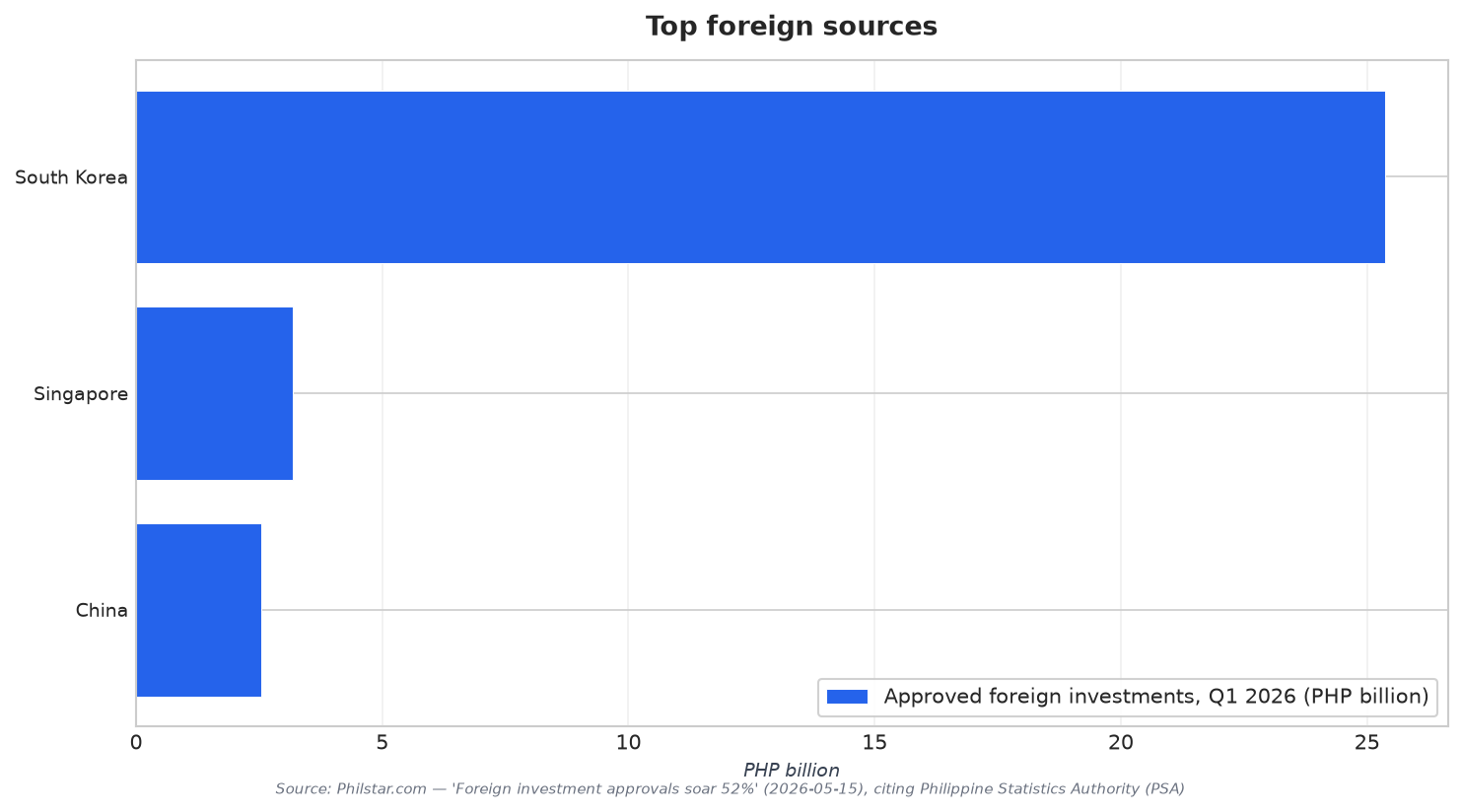
Early-2026 indicators show momentum in project pipelines even as totals can move unevenly. Philippine Statistics Authority data reported by Philstar says foreign investment pledges approved by investment promotion agencies surged 52 percent year-on-year in the first quarter to P42.64 billion, from P27.99 billion in the same period last year. South Korea contributed P25.37 billion or 59.5 percent of that first-quarter total, followed by Singapore at P3.18 billion (7.5 percent) and China at P2.54 billion (5.9 percent). Central Luzon drew P33.08 billion or 77.6 percent of approved foreign pledges, well ahead of Calabarzon at P3 billion (seven percent) and the National Capital Region at P2.13 billion (five percent).
What CREATE MORE Changes in Practice for 2026 Projects
A key 2026 takeaway is that incentive planning is no longer just about finding a “good zone,” but about selecting an incentive structure under a harmonized framework. A 2026 review of incentives explains that the CREATE Act rationalised the incentive menu across all IPAs, while the CREATE MORE Act (R.A. 12066), enacted in 2024, further refined incentive duration, administration, and the choice between an enhanced deductions regime and a special corporate income tax. In plain terms, incentives strategy becomes a modeling exercise: activity eligibility, which IPA will administer the benefits, and whether a deductions path or special tax path better fits the project’s economics and compliance capacity.
Investors are also pairing incentive choices with ownership planning. A 2026 foreign investment law guide says the Foreign Investments Act allows as much as 100% foreign participation in most enterprises, except areas reserved for Philippine nationals under the constitution, special laws, and the Foreign Investments Negative List. It adds that in 2022 the law was amended to lessen restrictions and allow foreign nationals to invest up to 100% equity in Micro and Small Domestic Market Enterprises engaged in advanced technology, startup, or startup enablers, where the majority of employees are Filipinos. That combination—ownership clarity plus the Philippines CREATE MORE Act incentives environment—can change whether a foreign investor needs a local joint-venture partner for a specific plan.
Sector examples also show why regime selection matters. A 2026 BPO industry statistics source states that PEZA offers income tax holidays of 4–6 years for registered firms, followed by a 5% special corporate income tax rate, and that the CREATE Act reduced the standard corporate income tax from 30% to 25% for large corporations (and 20% for SMEs with taxable income below PHP 5 million). It also says the CREATE Act extended income tax holidays up to 7 years for highly desirable activities, including IT-BPM, and offered an enhanced deduction regime as an alternative to the special corporate income tax. For 2026 decision-making, this reinforces a simple discipline: map your activity, model the trade-offs, and align the registration choice (BOI, PEZA, or a freeport authority) with how the incentives will be administered under CREATE and CREATE MORE.
What does the CREATE MORE Act mean for investors evaluating the Philippines in 2026?
What do recent figures say about foreign investment interest in the Philippines?
How should companies choose between BOI, PEZA, and freeport incentives in 2026?
What do the Philippines CREATE MORE Act incentives look like for IT-BPM or BPO-style investments?