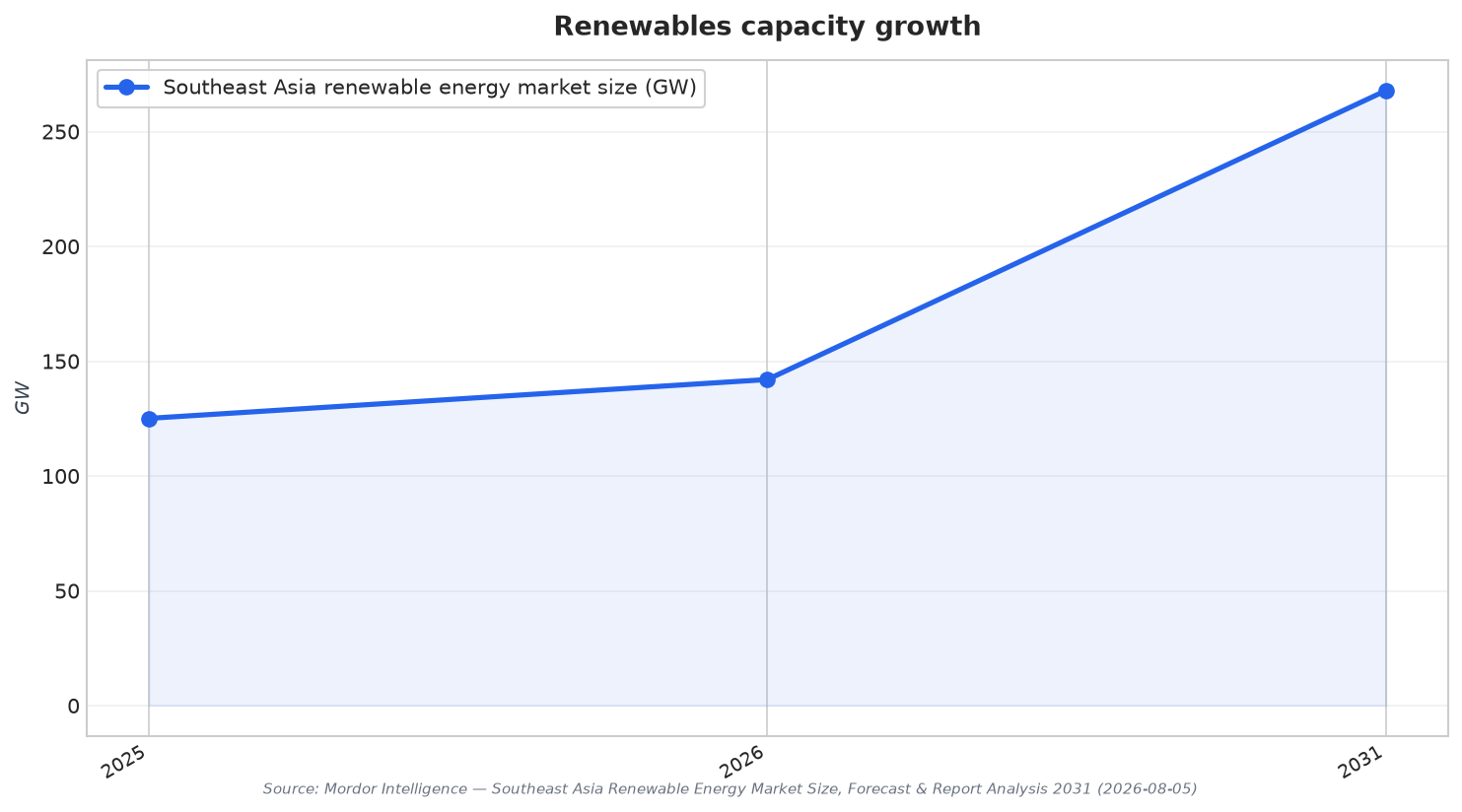
Southeast Asia is expanding renewable capacity quickly, and manufacturing is becoming a more visible driver of that buildout. Mordor Intelligence values the Southeast Asia renewable energy market at 125.10 GW in 2025 and estimates it will grow from 142.01 GW in 2026 to 267.84 GW by 2031, a 13.52% CAGR for 2026–2031. Within that context, commercial and industrial PPAs are projected to advance at a 16.14% CAGR through 2031, signaling rising appetite for contract structures that help factories source cleaner electricity. In 2025, hydropower led with 51.35% of market share, while the competitive field stayed fragmented: ACEN, B.Grimm Power, and Gulf Energy together controlled less than 10% of regional capacity.
Export-linked corporate commitments are directly shaping where deal activity concentrates. Mordor’s report notes that corporate RE100 programs in export-oriented sectors are spurring commercial and industrial demand, especially in Thailand’s automotive clusters and Vietnam’s electronics parks. Vietnam’s scale matters in this conversation: it commanded 41.55% of Southeast Asia capacity share in 2025, and in the Southeast Asia solar market it generated 53.37% of regional capacity in 2025. The solar segment itself is large enough to change procurement options, with Mordor sizing Southeast Asia solar at 43.82 GW in 2026 and forecasting 99.04 GW by 2031 at a 17.72% CAGR, which expands the pool of potential projects that can be contracted via corporate offtake.
What 2026 PPA Structures Mean for Factory Operations
Policy and market design are making corporate procurement more practical, but risk management is becoming part of the factory energy conversation. Renewable Advisory Experts points to Vietnam’s long-awaited Direct PPA pilot, which allows large energy users to buy directly from renewable generators through the grid, and says Southeast Asia (including the Philippines and Vietnam) is “breaking new ground.” The same source highlights common contracting risks: market price swings below contracted levels, and a broader move toward collars, caps, and indexation; volume risk in pay-as-produced PPAs; and shape risk from mismatch between renewable output and a buyer’s load profile. For a Southeast Asia corporate renewable PPA strategy, these details influence how procurement teams balance cost visibility with operational reality.
New corporate deals are also showing how manufacturers want clean energy delivered. In Vietnam, Mordor reports that the 380 MWp KN Srêpốk 3 floating plant signed a direct PPA with Samsung and begins construction in July 2026. Alongside PPAs, government-led procurement is building supply that can support contracting, with Mordor noting the Philippines’ Green Energy Auction aims to procure 25 GW annually from 2027, including 3.2 GW of solar in its sixth round. These pathways sit beside company-led contracting, giving manufacturers multiple routes to credible offtake, even as transmission delays remain a constraint in parts of the region.
Storage is increasingly part of the manufacturing decarbonization and reliability equation, which changes how PPAs are designed and valued. IndexBox states the industrial backup and resilience segment accounts for 20% of the Southeast Asia battery market in 2026, driven by reliability needs in manufacturing plants, data centers, telecommunications, and remote industrial sites. The same source describes co-location of solar and wind with battery storage for optimized output and explicitly flags corporate PPAs as driving demand for utility-scale renewable-plus-storage projects. In parallel, green financing is targeting projects that match industrial load shapes: Mordor notes Singapore’s Green Bond Framework aims to target SGD 35 billion of sustainable issuance by 2030, and highlights Temasek partnering with BlackRock’s USD 1.4 billion climate fund, alongside the Norwegian Climate Investment Fund’s USD 55 million equity investment in Indonesia’s Xurya.
How fast is Southeast Asia’s renewable capacity expected to grow from 2026 to 2031?
Why are corporate PPAs becoming more relevant for manufacturers in Southeast Asia?
What’s a 2026 example of a direct PPA linked to manufacturing demand?
What contract risks should buyers watch in corporate renewable PPAs?
How is battery storage showing up in factory energy planning in 2026?