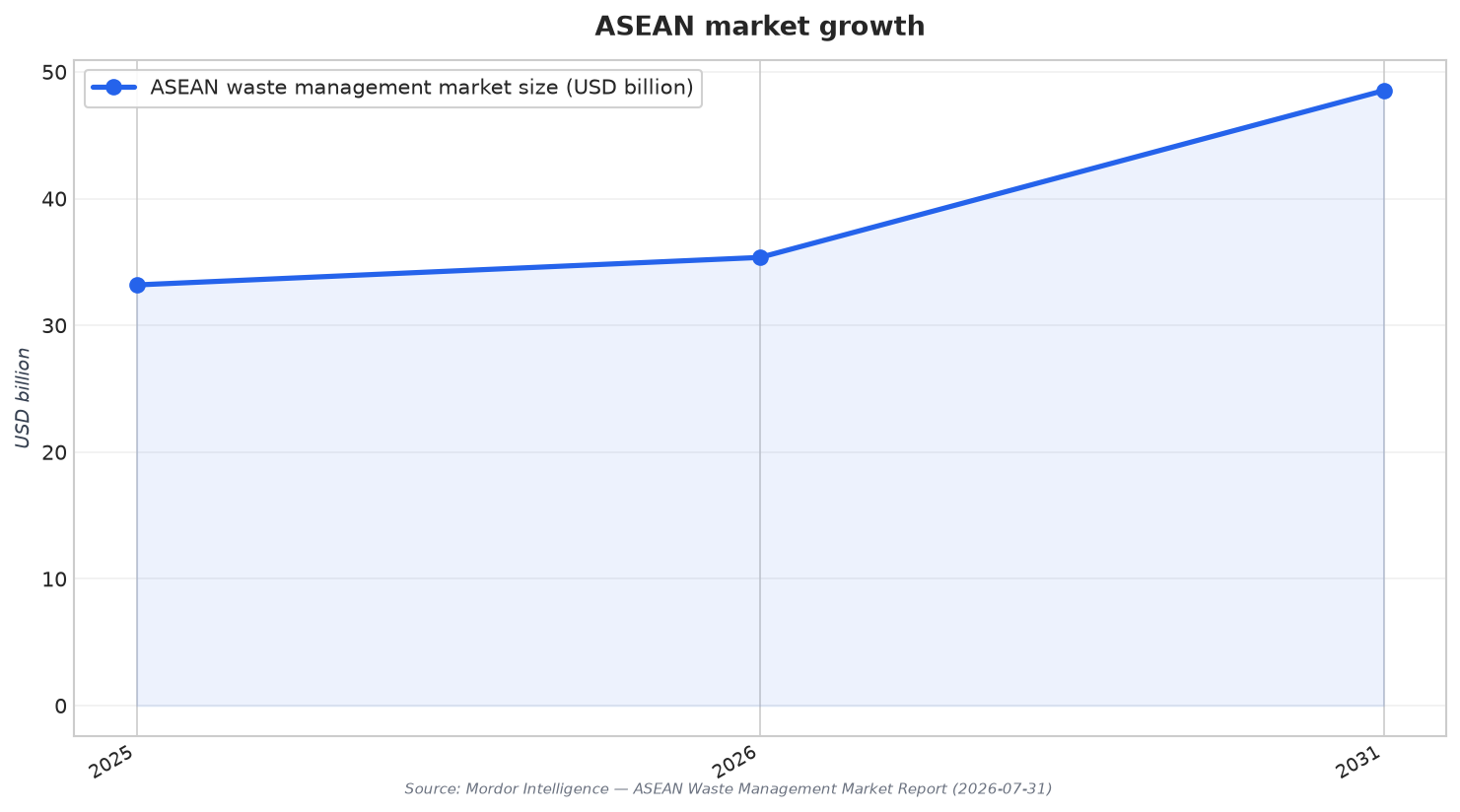
In 2026, the case for scaling ASEAN electronics waste recycling is getting stronger because the region’s waste economy is expanding and regulation is tightening. Mordor Intelligence estimates the ASEAN waste management market at USD 35.36 billion in 2026, up from USD 33.19 billion in 2025, with projections reaching USD 48.52 billion by 2031 at a 6.54% CAGR (2026–2031). Inside that broader system, e-waste is one of the faster-moving streams, advancing at a 7.33% CAGR to 2031, while recycling and resource recovery are projected to grow at an 8.42% CAGR. These trends matter for industrial planners because they point to rising volumes, larger budgets, and a shift toward higher-value processing rather than basic disposal.
Policy design is also changing the business fundamentals. The same ASEAN report points to government-led Extended Producer Responsibility (EPR) schemes as a source of compliance pressure and more predictable funding for infrastructure, citing Vietnam’s Decree 05/2025/ND-CP as an example. Alongside EPR, waste-to-energy (WtE) programs in Indonesia, Vietnam, and Thailand are part of the investment landscape, and Vietnam’s feed-in tariffs of USD 0.11 (VND 2,575.18) per kWh for WtE power show how incentives can create bankable revenue floors. For e-waste recyclers, the industrial takeaway is not that WtE replaces recycling, but that governments are getting more comfortable building financeable waste assets, which can spill over into collection networks and formal processing capacity.
From Waste to Feedstock: Building a Regional “Circular Chip” Supply Chain
Industry advocates are explicitly framing waste as an industrial input, not just an environmental liability. A SunStar report describes how sustainability investors and circular economy advocates see plastics, metals, and electronic waste as alternative inputs that can reduce import dependence and support manufacturing competitiveness. It also argues ASEAN could unlock a major industrial and trade opportunity by building integrated regional recycling supply chains similar to the region’s electronics manufacturing networks. The article notes a practical tension that industrial strategy must solve: even where local recycling exists, exporters may still ship recyclables out when overseas buyers offer higher prices, creating feedstock uncertainty for domestic plants.
Global and Asia-Pacific market signals reinforce why 2026 is a timely year to industrialize e-waste recovery. Mordor Intelligence estimates the global e-waste recycling market at USD 44.84 billion in 2026, with projections to USD 76.77 billion by 2031 at an 11.34% CAGR (2026–2031), and says Asia-Pacific held 46.25% revenue share in 2025. The same report notes EPR schemes in the European Union, India, and South Korea steered roughly 2.1 million t of e-waste into certified plants during 2024, illustrating how mandates can formalize supply for processors. On the investment side, MarketsandMarkets points to limited recycling capacity in emerging markets as both a barrier and an opportunity, and highlights a projected USD 4.9 billion market expansion in Asia-Pacific over its forecast period, with strategic partnerships expected to improve collection and processing.
The industrial opportunity in ASEAN is to connect policy, collection, and processing into a bankable system that can scale across borders. Mordor Intelligence reports that collection, transportation, sorting, and segregation represented 53.72% of ASEAN waste management market size in 2025, showing how much value sits upstream before materials ever reach a refinery. At the same time, the circular economy narrative is accelerating: The Business Research Company estimates the global circular economy market will grow from $517.79 billion in 2025 to $578.09 billion in 2026 at an 11.6% CAGR, and highlights stronger extended producer responsibility regulations as a forecast driver. If ASEAN aligns EPR implementation with cross-border “waste trade” logistics and higher-value metals recovery, it can turn discarded electronics into an industrial input pipeline that supports manufacturing resilience in 2026 and beyond.
Why is electronics waste recycling becoming an industrial opportunity in ASEAN in 2026?
What role do EPR policies play in scaling formal e-waste recycling?
How does the broader waste management market support e-waste recycling growth?
What global market context matters for ASEAN’s electronics recycling ambitions?