In 2026, the story is less about trade stopping and more about trade changing shape. The idea behind Myanmar border trade rerouting across ASEAN in 2026 is visible in how companies balance land corridors, port choices, and paperwork speed. Thailand’s border and transit trade combined is forecast around THB 1.09 trillion in 2026, a sign that overland movement remains economically important even amid transport and security headwinds. At the same time, US policy pressure is altering cost calculations across the region, with “reciprocal” tariff rates reaching up to 40% in markets such as Laos and Myanmar, 36% in Cambodia and Thailand, and around 20% in Vietnam, while Singapore is approximately 10%.
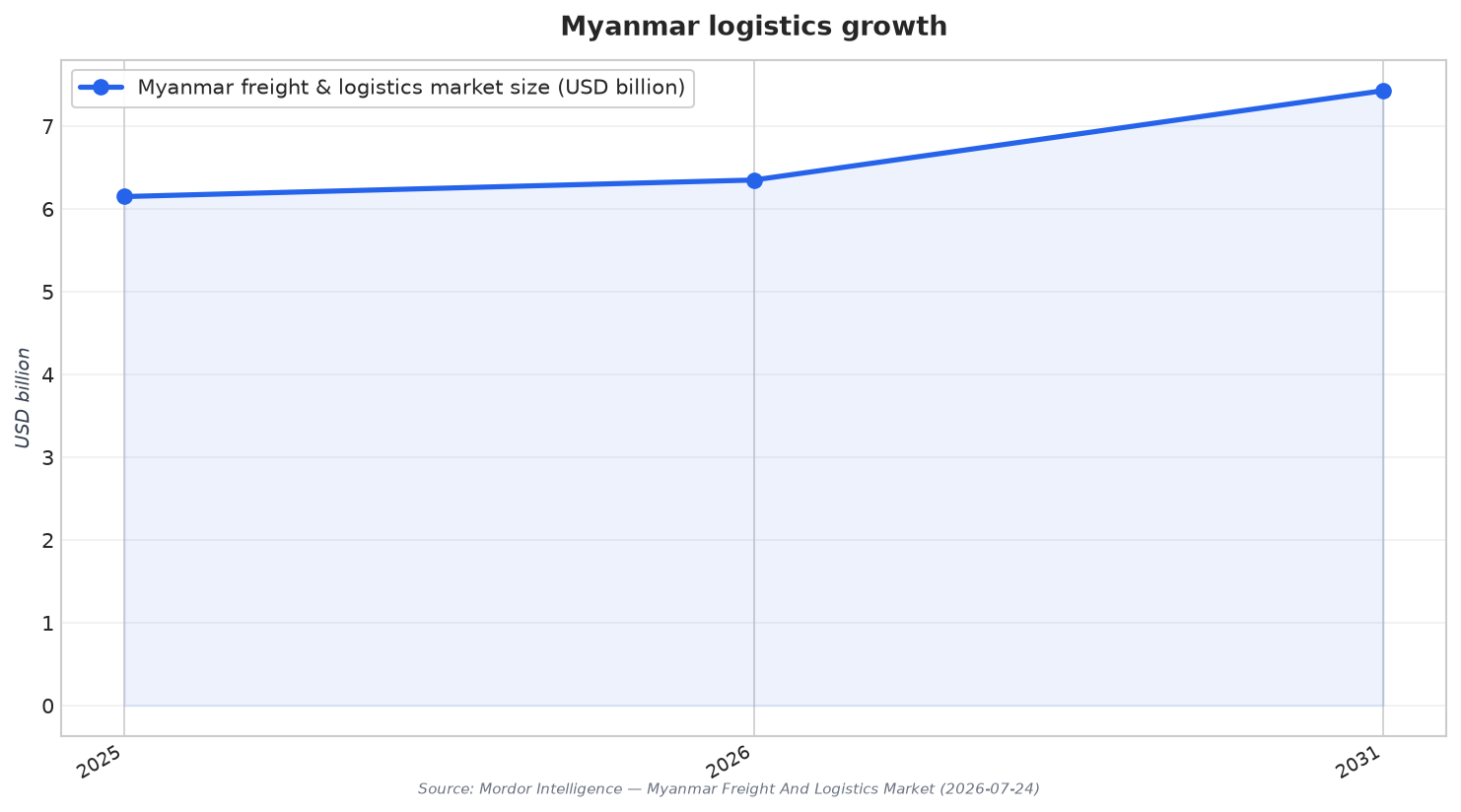
Myanmar’s own freight and logistics market is still projected to expand from USD 6.15 billion in 2025 to USD 6.35 billion in 2026, with a longer forecast to USD 7.43 billion by 2031 at a 3.21% CAGR over 2026–2031. That growth sits alongside friction points noted in the market outlook, including political instability, foreign-exchange controls, and fragmented last-mile networks. Structure also matters for rerouting decisions. In 2025, sea and inland waterways accounted for 79.02% of freight forwarding revenue share in Myanmar, while road freight transport captured 71.12% of freight transport segment revenue share. Those baselines help explain why shippers may mix modes differently when a specific gate, corridor, or clearance step becomes uncertain.
How Rerouting Happens: Customs, Corridors, and Control Points
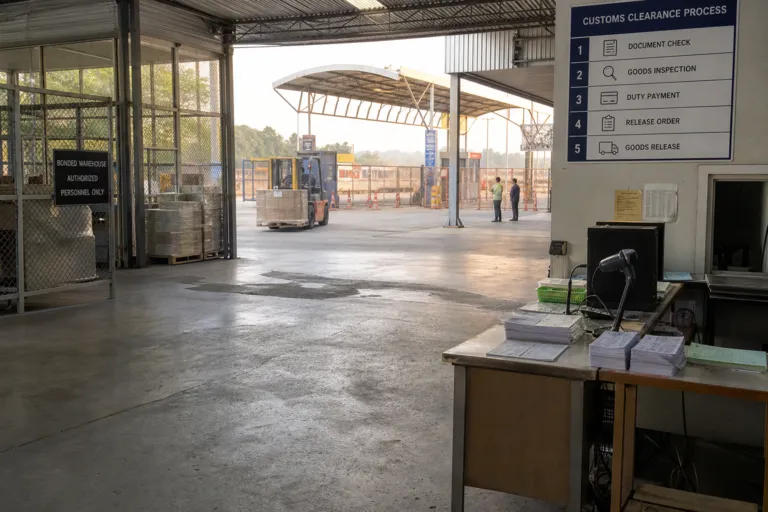
Rerouting is not only a map problem. It is also an execution problem. Market commentary highlights customs modernization and cross-border corridor activation, including digitization protocols that compress port clearance timelines and attract bonded warehouse investment into Thilawa Special Economic Zone. The ASEAN Single Window is also described as standardizing cross-border documentation between Myanmar, Thailand, and Vietnam, with the stated effect of reducing transit delays on road freight corridors. These systems matter because they reduce the penalty of switching lanes. They also help operators maintain visibility. The same logistics outlook identifies Track & Trace technology as a leading investment priority as shippers demand real-time visibility across the Thailand–Myanmar border.
Trade composition adds another layer to rerouting choices. Myanmar import data for 2025 shows total imports of US$ 14.79B, with Mineral Products at US$ 4.22B (28.5%), Textiles at US$ 2.28B (15.4%), and Chemical Products at US$ 1.56B (10.6%). The year-over-year pattern is uneven: imports grew by +18.8% in 2025 vs 2024 (from US$ 12.45B to US$ 14.79B), after declines of -24.3% in 2024 vs 2023 (US$ 16.44B to US$ 12.45B) and -5.5% in 2023 vs 2022 (US$ 17.40B to US$ 16.44B). China was Myanmar’s top import trade partner in 2025 at US$ 5.95B, followed by Singapore at US$ 2.65B and Thailand at US$ 1.60B, figures that shape how shippers prioritize stable lanes and documentation processes.
The broader regional context reinforces why ASEAN supply chains keep rebalancing. McKinsey notes that imports from China continued to fall as firms rerouted supply chains toward alternative suppliers, particularly in ASEAN economies, while purchases of AI-related goods rose sharply. That same view points to electronics supply chain shifts where ASEAN and India gained share, particularly in smartphones and laptops. Within Myanmar’s logistics market structure, freight transport represented 60.15% of market share in 2025, and wholesale and retail trade contributed 33.12% of market size in 2025. When these demand signals combine with digitized clearance and standardized documents, supply chains find ways to route around disruptions while still using the region’s established border and port ecosystems.
What does Myanmar border trade rerouting across ASEAN look like in 2026?
How large is Myanmar’s freight and logistics market in 2026?
Which transport modes dominate Myanmar’s logistics mix?
What are Myanmar’s biggest import sectors and partners in the latest data?
What 2026 factors are pushing companies to rethink ASEAN routing choices?